
Review · USA
Learn to Surf – Pensacola Beach
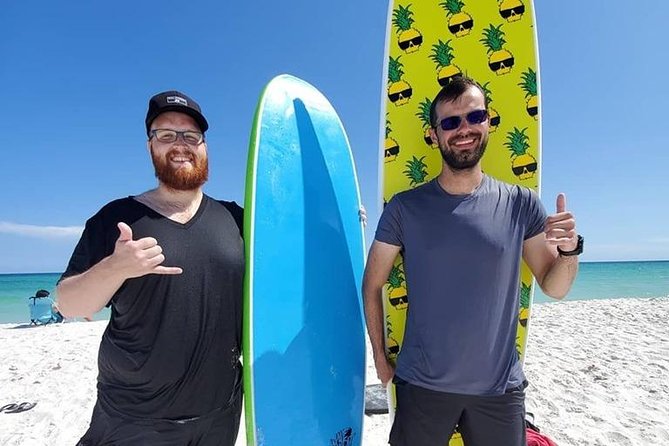
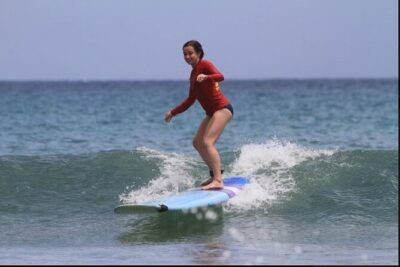
Pensacola’s beginner surf lesson gives you a real chance to stand on a board during your first time in the Gulf. The class starts on land with safety, stretching, paddling, and the pop-up, then moves into the water where your instructor can help position you and push you into suitable waves.
I like the small maximum of 10 people, since a first surf lesson works best when the instructor can watch your form. I also like that the class welcomes children and adults together, with former students ranging from a 13-year-old and a parent to a 40-year-old first-timer who got upright after a few tries.
The main thing to consider is that surfing depends on the day’s conditions. Wind, waves, weather, and the number of people in the class can affect how much time you spend practicing and how easy it is to catch a wave.
Key points to know before you book
- About 90 minutes of instruction and board use: The full activity lasts about two hours, with time for both land teaching and water practice.
- A true first-timer lesson: You’ll learn prone position, paddling, the pop-up, stance, water safety, and surf etiquette before heading out.
- Small-group coaching: The class is limited to 10 people, allowing the instructor to give more individual help.
- All ages are welcome: Children and adults can take the lesson, making it a useful family activity.
- Experienced instructors focus on calm coaching: Kai, Malachi, AJ, Braden, and AC are among the instructors named by past participants, with patience and encouragement as common themes.
- You must bring sun and cold-water protection: A surfboard and bottled water are supplied, but sunscreen and a rash guard or wetsuit are not.
Starting beside the Pensacola Beach Pier
You meet at Pensacola Beach Pier, at Pensacola Beach, Florida. The pier gives you a clear public meeting point, and the activity finishes back there after the lesson.
The setting matters. You are not being taken to an indoor pool or a practice machine. You’ll be learning at the beach, close to the Gulf Pier, with the actual water conditions shaping the class. That makes the lesson feel like a proper introduction to surfing rather than a dry run.
The exact wave conditions are not fixed, so you should arrive ready for the instructor to adjust the session. The group begins with a report on current conditions and marine life. That is useful for more than local color. It helps you understand what the water is doing before you paddle out and gives the instructor a chance to explain any concerns specific to that day.
The meeting location is near public transportation, which may help if you are staying in the Pensacola Beach area. The supplied details do not specify parking arrangements, changing facilities, or a locker area, so I would avoid assuming those services are included.
More Beginner Surf Lessons in the USA
- Maui: Two Hour Beginner Group Surf Lesson in Kihei
★ 5.0 · 950 reviews - Oahu: Beginner-Friendly Waikiki Beach Surfing Lesson
★ 4.9 · 425 reviews - Oahu: Waikiki 2-Hour Beginner Group Surf Lesson
★ 4.9 · 191 reviews
The first lesson happens on land
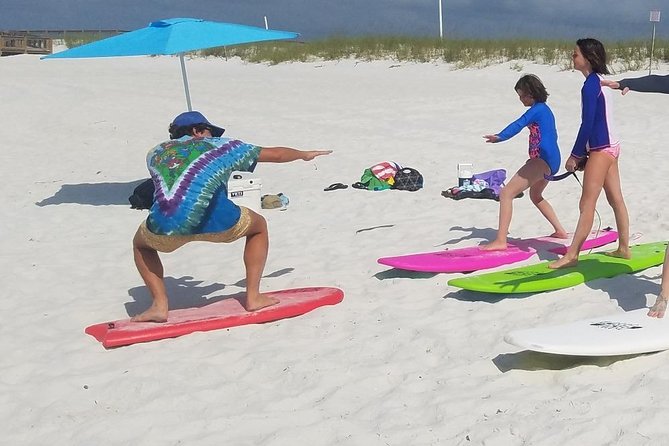
The class does not send you straight into the waves. You begin with a group introduction, a water-safety briefing, and a review of surf etiquette. Then you stretch before working through the basic movements on land.
That order is sensible. A new surfer has a lot to remember at once: where to place your hands, how to push your chest up, when to bring your feet underneath you, and how to keep your balance. Practicing the sequence before entering the water gives you something familiar to repeat when the board starts moving.
You’ll work on the proper prone position first. This is the way you lie on the board while paddling. The instructor then covers paddling technique, the pop-up, and your stance once you are standing.
The pop-up is the key moment for most beginners. You move from lying flat to standing in one quick motion, so the land lesson helps turn a complicated movement into a series of steps. You should expect to need several attempts. One first-time surfer needed a few tries before standing, then found the movement began to make sense once it worked.
The instructor also decides how much time to spend explaining the best way to get through the water. Depending on conditions, you may practice methods such as a log roll or other ways to handle the board and incoming waves. The amount of this instruction can change from one session to another, so the lesson is not a rigid script.
From beach practice to the Gulf water
Once the land work is complete, you take the board into the water. The instructor helps each person find a suitable position in the lineup, the area where surfers wait for waves, and can push you into a wave if you need help getting started.
That hands-on assistance is especially useful for a beginner. It lets you concentrate on the pop-up and stance instead of trying to judge every part of the wave by yourself. You are still learning the basic skills, but you are not left to guess where to sit or when to try.
The experience is designed around catching a wave, not simply lying on a board near shore. You may stand after a handful of attempts, as several first-time participants did, but you should treat standing as a possible result rather than a promise. Conditions and balance differ from person to person.
The instructor’s role can make a large difference here. Kai is described as patient and attentive, including when helping a younger participant. Malachi is noted for explaining the technique in a calm, comfortable way, while AC is praised for keeping an encouraging attitude with a parent and 13-year-old child. Those details suggest that the teaching style is more supportive than hard-driving, which is exactly what most beginners need.
What the two-hour schedule really gives you
The activity lasts about two hours, but the planned instruction and board rental total about 1.5 hours. The remaining time covers the group welcome, conditions report, safety talk, stretching, transitions, and getting into position.
That is a good length for a first lesson. Surfing asks more of your arms, legs, and balance than it may appear from the beach. A two-hour appointment gives you enough time to learn, practice, rest briefly between attempts, and try again without turning the lesson into an all-day physical test.
You should still arrive with a moderate level of physical fitness. Paddling and repeatedly getting up from the board take effort, even when the waves are small. The class is open to all ages, but that does not mean every person will find the physical work easy.
If you are booking for a family, keep the different learning speeds in mind. A child may pop up quickly, while an adult needs more repetitions, or the reverse may happen. The small group size helps, but the session still follows one shared schedule.
Same water, another way to ride it:
- UTV Dune Cruise and Surf at Coral Pink Sand Dunes
★ 5.0 · 785 reviews - Open Group Surfing Lesson in Waikiki, Hawaii
★ 4.5 · 582 reviews - Outrageous Surf ScHool Lesson on Lahaina Side
★ 4.5 · 547 reviews - Los Angeles: Surfing Lesson in Venice Beach
★ 4.8 · 442 reviews
Why the group size matters
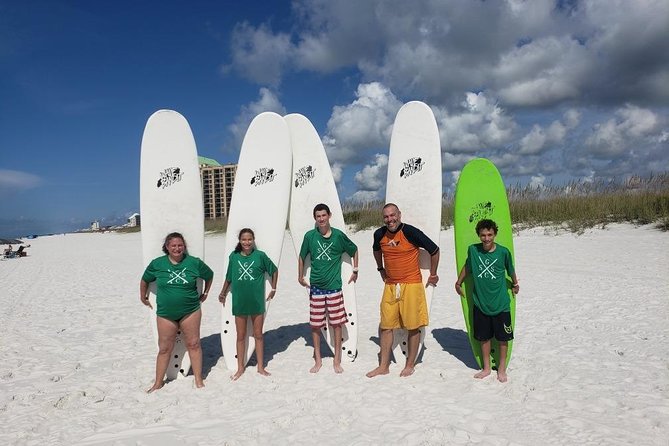
The maximum group size is 10 people. That is not a private lesson, but it is small enough for the instructor to keep an eye on individual form and help with wave placement.
For beginners, personal attention matters most during the pop-up and the first few attempts in the water. A short correction can prevent you from repeating the same mistake for the rest of the lesson. The instructor can also offer a push when you need help catching the wave, then let you try to repeat the movement on your own.
The class has also received strong marks for its staff. Every available rating is positive, and the instructors named by participants include Kai, Malachi, AJ, Braden, and AC. The strongest pattern is not a promise of perfect waves. It is the instructors’ patience, clear explanations, and willingness to work with both adults and children.
That should appeal to you if you feel nervous about trying a sport in front of other people. You are not expected to arrive with surf knowledge. The lesson is built for people who have never stood on a board.
Board rental and what you need to bring
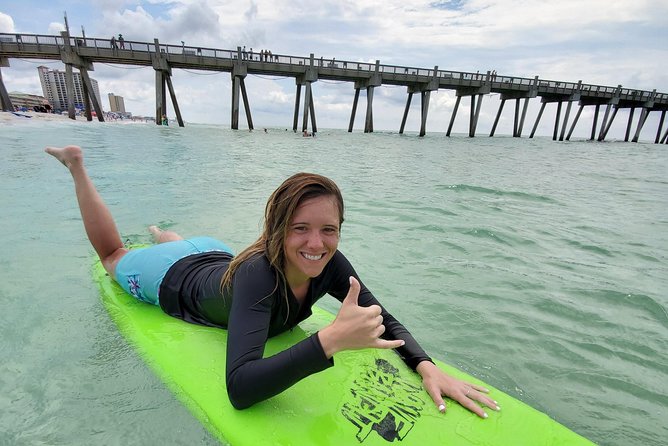
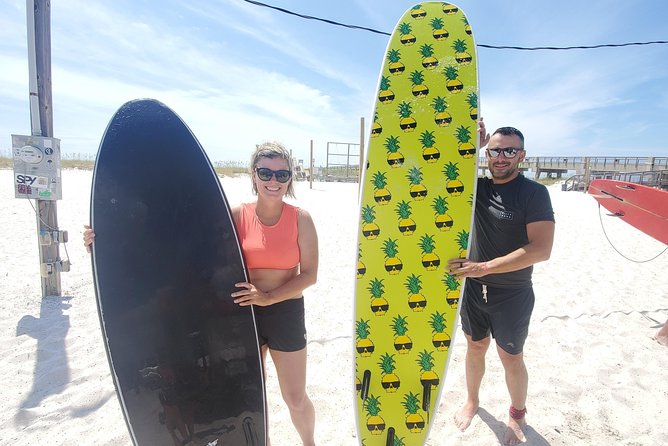
A surfboard and bottled water are included. Having the board supplied makes the activity easier to plan, especially if you are visiting Pensacola and do not want to arrange equipment separately.
Sunscreen is not included, and neither is a rash guard or wetsuit. You should plan for those items yourself. The supplied information does not state whether either clothing item is required on a particular day, since that can depend on conditions, but you should not count on the school providing them.
Sun protection is particularly important for an activity that keeps you outdoors and on reflective water. A rash guard can also make the session more comfortable, while a wetsuit may be useful in cooler conditions. Since the lesson schedule runs from 9:00 a.m. to 5:00 p.m. daily during the listed operating period, you may have some choice over the time of day, subject to availability.
The experience is offered in English. Confirmation is provided at booking, and the activity is available throughout the week according to the stated operating hours.
Weather and changing surf conditions
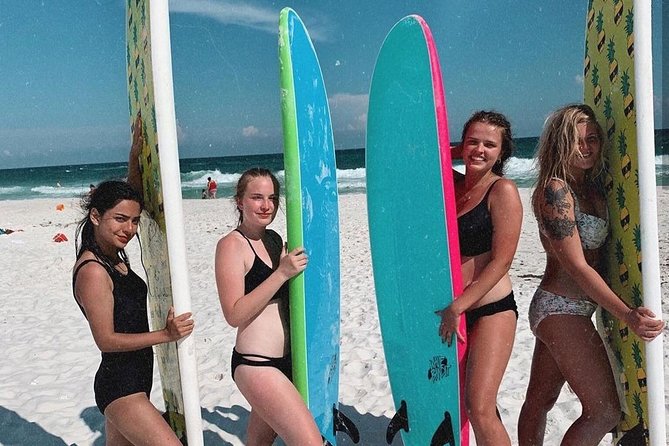
Surfing is unusually dependent on weather. If conditions are poor, the lesson can be canceled and you will be offered another date or a full refund.
That policy is fair, but weather is still something to plan around. Do not build your entire day around the lesson if you have no flexibility, especially during a short stay. The experience also requires a minimum number of people, so it can be canceled if that number is not reached. In either case, the stated options are a new date or a full refund.
Even when the lesson runs, the conditions may shape the content. The instructor decides how much time to spend on paddling out and related techniques, and the size or strength of the waves affects how much help you receive. A calm day may be easier for learning the basic movements, while stronger conditions could make the water portion more demanding.
The best approach is to judge success by what you learn, not only by how long you ride. Standing on the board is a memorable goal, but learning safe habits and the proper body position gives you something useful to carry into a future lesson.
The value of the experience
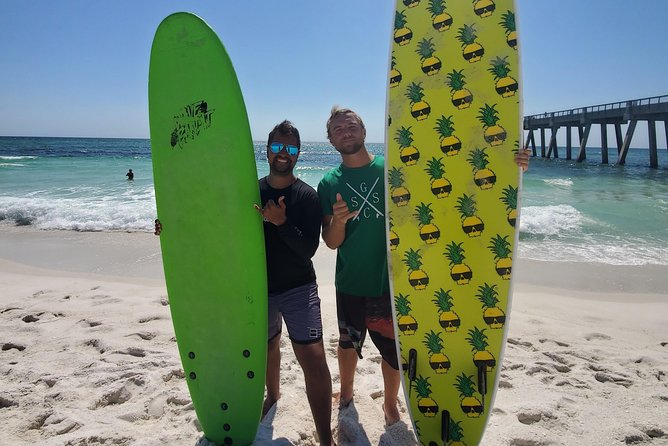
No price is provided here, so I cannot judge the exact dollar value. I can explain what you are paying for: about two hours at the beach, a surfboard, bottled water, instruction on land and in the water, safety guidance, and direct help from an instructor.
Compared with arranging a board and teaching yourself, the lesson offers a clearer starting point. You learn the basic movements in the right order, receive guidance on etiquette, and get help with positioning. For a first attempt, that can save plenty of frustration.
The value is strongest if you are genuinely curious about surfing but do not want to commit to a longer course. The session gives you a taste of the sport without requiring a full day. It also works well as a family activity because adults and children can join the same lesson.
The value is weaker if you already surf confidently. The class is designed for beginners, and the teaching time will focus on basic position, paddling, pop-ups, and stance. An experienced surfer may find the material too simple.
Who should book this Pensacola lesson
I would choose this activity if you have never surfed, want a guided first try, or need a family-friendly beach activity that gets you into the water. It is also a good fit if you like learning by doing and would rather attempt a real wave than watch a demonstration from shore.
The class may suit you especially well if you are worried about feeling out of place. The instructor names associated with the lesson are repeatedly linked with patience and encouragement. That tone can matter as much as the technical teaching during a first session.
You should think twice if you dislike variable weather or want a guaranteed schedule with no chance of a cancellation. You should also consider your fitness level, since the class requires repeated paddling and standing movements.
The lesson is not a promise that everyone will surf across the beach on the first attempt. It is a structured chance to learn the basics, get help in the water, and possibly stand up after only a few tries.
Booking, cancellations, and practical details
Free cancellation is available if you cancel at least 24 hours before the start time. Cancellations or changes made less than 24 hours before the activity are not accepted for a refund, and the cut-off follows local time.
The experience operates Monday through Sunday from 9:00 a.m. to 5:00 p.m. The stated operating dates run through December 8, 2026. Confirmation is received at booking, and the meeting and ending point are both at Pensacola Beach Pier.
The maximum group size is 10 people. The experience is offered in English, includes mobile ticketing, and requires a moderate physical fitness level.
Should you book Learn to Surf at Pensacola Beach?
Book it if you want a friendly, practical introduction to surfing and you are happy to let the day’s conditions shape the lesson. The included board, small group, water-safety briefing, and hands-on wave assistance make it a sensible first step.
I would be most comfortable booking this for a beginner family or for an adult who has always wanted to try surfing but feels unsure about starting alone. Bring sunscreen and suitable water clothing, keep your expectations realistic, and treat standing up as a welcome bonus rather than a guarantee.
If you already surf or need a fully weather-proof activity, choose something else. For everyone else, this offers a focused two-hour introduction with instructors who put patience and clear coaching ahead of showmanship.
FAQ
How long does the surf lesson last?
The activity lasts approximately two hours. About 1.5 hours are planned for instruction and surfboard rental, with the remaining time covering introductions, conditions, safety, stretching, and transitions.
Where does the lesson meet and finish?
The lesson meets at Pensacola Beach Pier in Pensacola Beach, Florida. The activity ends back at the same meeting point.
Is the lesson suitable for children?
Yes. Children and adults of all ages are welcome, although participants should have a moderate level of physical fitness.
What is included with the lesson?
A surfboard and bottled water are included. Sunscreen and a rash guard or wetsuit are not included.
How many people can join the class?
The activity has a maximum of 10 participants.
What happens if the weather is poor?
If poor weather causes the lesson to be canceled, you will be offered a different date or a full refund. The same options apply if the minimum number of participants is not reached.
Latest surf sessions around the USA
- Waikiki: Family, Private, and Group Surfing Lessons★ 5.0 · 4 reviews
- Waikiki: Surf Lessons Easy 60 min classes no crowds!★ 4.9 · 21 reviews
- Astonishing Scavenger Hunt: Surf, Sand and Sculptures!★ 3.0 · 2 reviews
- Two- Hour Group Surfing Lesson in Cocoa Wrightsville Beach, NC★ 5.0 · 13 reviews
- Electric Bike Rentals in Topsail Island and Surf City★ 5.0 · 2 reviews
- Surf Lesson in Santa Barbara★ 3.0 · 2 reviews
- 1-on-1 Private Surf Lesson in Santa Barbara★ 5.0 · 4 reviews
- Surf lesson with KTO Yoga Surf★ 4.0 · 5 reviews
USA Surf Lessons, compared.
Maui: Two Hour Beginner Group Surf Lesson in Kihei
Read our review →
UTV Dune Cruise and Surf at Coral Pink Sand Dunes
Read our review →

Oahu: Beginner-Friendly Waikiki Beach Surfing Lesson
Read our review →
Private Hanalei Sandy Bottom Surf Lesson on Kauai
Read our review →Browse the lists this tour appears in