
Review · KAUAI
Kauai’s Ultimate Group Surf Lesson
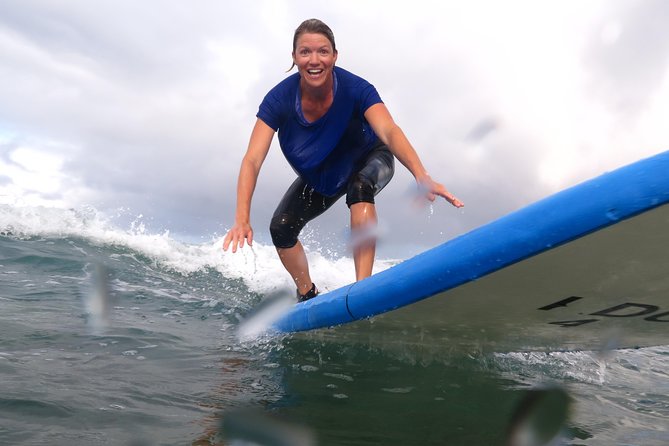
Kauai’s Ultimate Group Surf Lesson gives beginners a real shot at standing on a board during a first Hawaiian surf session. The setup is simple: meet near Poipu Beach, collect your board and gear, learn the basics on land, then spend most of the 90-minute lesson in the water with an instructor nearby. Adam, Austin, Kai, Tom, and Hudson are among the instructors associated with particularly successful sessions.
I like the small instructor-to-student ratio, capped at five students per instructor, and I like that the price includes the board, rash guard, and water shoes. The main consideration is physical: you should be comfortable in the ocean and able to swim. Conditions can also change, and the water is not always equally easy for first-timers.
Key points to know before you book
- Poipu Beach setting: The lesson meets at 2440 Hoonani Road in Koloa and uses the Poipu Beach area, a convenient choice for a first surf lesson.
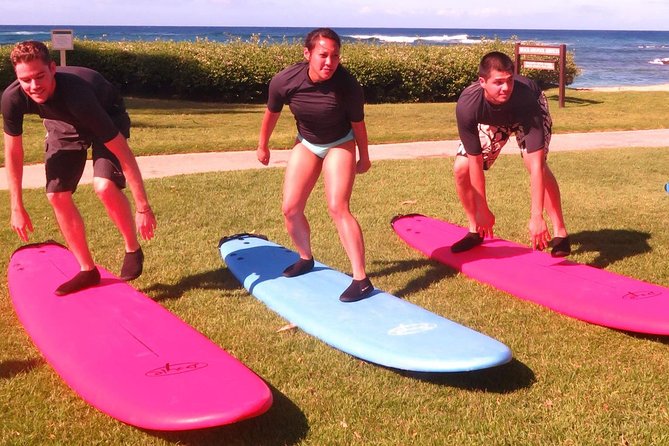
- A proper beginner introduction: You start with land instruction covering surfing fundamentals and ocean safety before entering the water.
- Small groups matter: No more than five students are assigned to each instructor, within a maximum group size of 16.
- Useful gear is included: You receive a surfboard, rash guard, and water shoes. Bring your own towel.
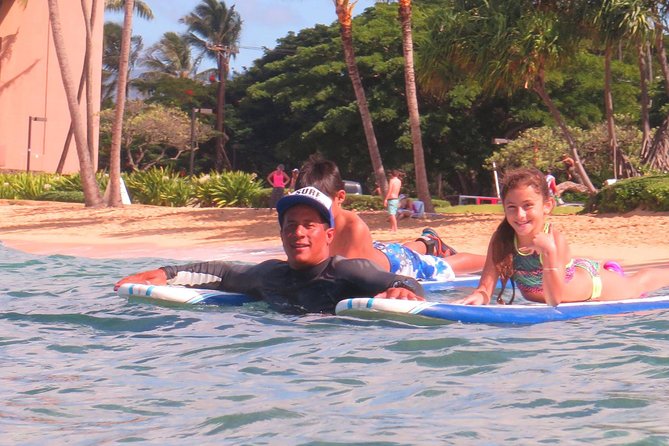
- Strong family appeal: Children as young as seven and eight have successfully stood on the board during family sessions.
- Weather can change the plan: Poor conditions may lead to a new date or a full refund, which is better than forcing a lesson into unsafe surf.
Why this Kauai lesson works for first-time surfers
Surfing looks easy from the beach. It is not. You need to judge a wave, lie on the board, push up at the right moment, place your feet correctly, and keep your balance while the water moves beneath you. A good first lesson breaks that sequence into manageable steps.
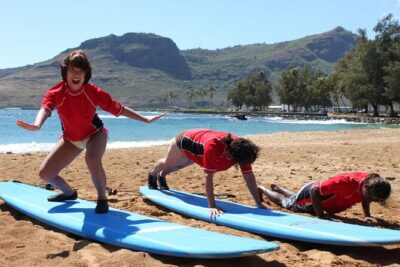
That is the strength of this Kauai session. You are not simply handed a board and pointed toward the waves. The lesson begins on land, where the instructor explains the basic fundamentals and ocean safety. That short briefing gives you a chance to learn the movements before trying them in moving water.
You then spend the rest of the session in the ocean. At around 90 minutes, the lesson is long enough for repeated attempts but not so long that most beginners are likely to lose all their energy. Surfing is a real workout, especially when you are paddling back out after a fall.
I also like the fact that the lesson is aimed at complete beginners. You do not need previous surf experience, and the equipment is supplied. That makes it easier to fit into a family holiday or a first visit to Hawaii without buying gear or working out what kind of board to rent.
More Group Surf Lessons in the USA
- Maui: Two Hour Beginner Group Surf Lesson in Kihei
★ 5.0 · 950 reviews - Open Group Surfing Lesson in Waikiki, Hawaii
★ 4.5 · 582 reviews - Waikiki Private Group Surf Lesson
★ 5.0 · 298 reviews
Meeting in Koloa and getting ready at Poipu Beach
The listed meeting point is 2440 Hoonani Road, Koloa, Hawaii 96756. The activity ends at the same meeting point, so you do not need to arrange a separate return transfer.
Poipu is one of the more practical parts of Kauai for a first surf lesson. The area is easy to reach, is near public transportation, and has a well-known beach setting. Some families have used a rideshare service from a cruise port and found the trip manageable, though you should allow enough time for traffic and check your pickup plans carefully.
The exact arrival routine is not complicated. You check in, receive the supplied equipment, and prepare for the land lesson. The package includes a surfboard, rash guard, and water shoes. A rash guard helps protect your skin from the board and sun, while water shoes can be useful around a rocky shoreline.
Towels are not included. Bring one from your hotel or rental, along with whatever dry clothes you want after the lesson. The available information does not specify storage arrangements, so keep valuables to a minimum and ask the operator where personal items should go when you arrive.
The land lesson: small details that make a difference
The land portion covers the basic mechanics of surfing and key ocean-safety points. For a beginner, this is not filler. It is where you learn how to position yourself on the board, how to move from lying down to standing, and what to do before heading into the water.
Pay close attention to the foot placement and timing. A beginner often tries to stand too early or pulls the body up in one awkward movement. The instructor can show you how to move in a controlled way, which is much easier to understand on land than after a wave has already picked up the board.
The safety briefing also matters. The water may look friendly, but the ocean has current, uneven footing, and moving boards. One family specifically noted large rocks in the area and advised care near them. That is a useful reminder to follow the instructor’s directions and avoid treating the shoreline like a swimming pool.
The small-group format should help here. With no more than five students per instructor, you have a better chance of receiving corrections tailored to your stance and timing. The total activity can include up to 16 people, but the important number is the instructor group, not the overall count.
Into the water for repeated attempts
After the land instruction, you take the board into the water for the main part of the lesson. The goal is not to master surfing in one morning. The realistic goal is to understand the basics, catch several small waves, and gain enough confidence to continue practicing.
The instructors’ role is especially important at this stage. Adam is repeatedly associated with patient, encouraging instruction, while Austin has helped families with children ranging from seven to 41. Kai has also worked with nervous beginners and young children, giving steady encouragement after falls. Tom and Hudson are other names connected with positive family sessions.
That does not mean every lesson will feel identical. One session with an instructor named Logan was described as friendly but light on specific advice. I would treat that as a useful reminder to speak up if you need a clearer explanation. Tell the instructor what feels confusing, ask for a correction, and do not wait silently for the technique to make sense on its own.
Conditions also affect the result. One session had waves that were more challenging than usual, while another had good beginner conditions. The operator has postponed a lesson when the waves were not suitable, which is a sensible policy. You may lose a convenient time slot, but a rescheduled lesson is preferable to being pushed into water that is beyond your comfort level.
Same water, another way to ride it:
- UTV Dune Cruise and Surf at Coral Pink Sand Dunes
★ 5.0 · 785 reviews - Outrageous Surf ScHool Lesson on Lahaina Side
★ 4.5 · 547 reviews - Los Angeles: Surfing Lesson in Venice Beach
★ 4.8 · 442 reviews - Oahu: Beginner-Friendly Waikiki Beach Surfing Lesson
★ 4.9 · 425 reviews
How successful is the first-wave goal?
Many beginners manage to stand at least once, and some families have had every member get upright. That includes groups with children and adults learning together. One family with children aged seven, eight, 10, and adults in their 40s all got up during the same outing.
You should still set a reasonable expectation. Standing on a board is possible, not guaranteed. Ocean conditions, fitness, balance, nerves, and the instructor’s ability to match the lesson to the group all play a part.
The most encouraging pattern is that the instructors focus on persistence without making the session feel like a test. Kai urged one student to try again after several wipeouts. That kind of support can make the difference between leaving frustrated and catching one more wave.
A first lesson is also more than the moment you stand up. You learn how to handle a board, read the basic movement of the water, and understand why timing matters. Even if you only ride briefly, you leave with skills that can help during future beach days.
Family suitability and physical demands
This is a good pick for families who want an active shared experience rather than another sightseeing stop. Parents can watch children improve from the beach or take part alongside them. The group format also makes it possible for family members with different confidence levels to learn together, provided they can manage the physical demands.
The activity asks for a moderate level of physical fitness. You will need to get on and off the board, paddle, push up, balance, and deal with repeated falls. Surfing can feel tiring even during a short lesson, especially if the waves require extra paddling.
You also need to be able to swim. This point is easy to overlook when you are thinking about the board and the instructor, but the ocean remains the ocean if you fall off. If you are not a swimmer, do not book this lesson for yourself.
Children have done well, but the supplied information does not give a specific minimum age. If you are booking for a young child, confirm the age requirements with Hawaiian Style Surfing before paying.
What the $121.86 price includes
At $121.86 per person, this is not a cheap beach activity. The value depends on how much you want from the morning.
The price includes the surfboard, rash guard, and water shoes, so you are not paying separately for basic gear. It also includes instruction, ocean-safety guidance, and the chance to practice with a small group. For a first-time surfer who wants a structured introduction, that package is more useful than renting a board without knowing how to use it.
The price makes less sense if you already surf well or only want casual time in the water. This is an instructional session for beginners, not a long independent rental. Intermediate surfers may find the lesson useful for a refresher, but the main design is to help someone stand up and gain confidence for the first time.
The 90-minute length helps the value. You get enough time to learn, try, fall, and try again without committing half a day to a single activity. For a family, the cost adds up quickly, so decide in advance who really wants to participate and who would rather watch from shore.
Timing, booking, and the cancellation rule
The lesson is commonly reserved about 28 days ahead, so I would not leave it until the last few days of a busy Kauai holiday. Confirmation is sent within 48 hours of booking, subject to availability.
The operator offers a mobile ticket and instruction in English. The activity is near public transportation, and rideshare access has worked for some people arriving from a cruise port. Still, allow extra time to find the meeting point and complete check-in.
You can cancel for a full refund up to 24 hours before the local start time. Cancellations or changes inside that window are not refunded. If poor weather cancels the lesson, you are offered another date or a full refund. The same applies if the minimum number of participants is not reached.
That policy makes trip planning important. Do not schedule the lesson so tightly that a late arrival, transport delay, or weather change ruins your only chance to surf. A morning slot may also leave room to adjust the rest of your day, but the exact start time is not provided here, so confirm it when booking.
The best reasons to choose this lesson
I would choose this activity for three main reasons. First, the instruction is built around beginners, not people who already know how to handle a board. Second, the five-to-one instructor limit gives you a fair chance of direct coaching. Third, the setting works well for a family day at Poipu.
The strongest part of the teaching style is the repeated emphasis on patience and encouragement. Adam, Austin, Kai, Tom, and Hudson are all associated with sessions where students felt supported and safe. That matters when you are trying a sport that can feel awkward in front of strangers.
I also value the operator’s willingness to postpone when conditions are poor. Surf schools can be tempted to run every scheduled session, but beginners need manageable waves. A change of date can be frustrating, yet it shows that safety is being taken seriously.
Points to consider before committing
Do not expect a private coaching session. Small group does not mean one instructor for one person. Your group may include children, adults, first-timers, and people with different fitness levels. The instructor has to divide attention among everyone.
Do not expect perfect waves every time. The ocean sets the schedule, not the lesson plan. Some sessions may have easy beginner conditions, while others can be more challenging. If you want guaranteed calm water, no surf lesson can promise that.
Finally, plan for the practical basics. Bring a towel, be ready for a workout, watch your footing near rocks, and make sure you can swim. Those details are simple, but they shape how comfortable you will feel once you leave the beach and enter the water.
Should you book Kauai’s Ultimate Group Surf Lesson?
Book it if you are a beginner who wants a structured, friendly introduction to surfing and you value having equipment and instruction handled in one package. It is especially well suited to families, couples, and solo visitors who want a genuine ocean activity without spending half a day on a larger excursion.
I would be more cautious if you cannot swim, dislike physical activity, or need a private instructor. I would also leave room in your schedule in case weather leads to a change of date.
For most first-timers who can manage the water and the $121.86 price, this is a sensible way to try surfing on Kauai. You may not leave as a surfer, but you have a good chance of leaving with your first wave, a better feel for the ocean, and enough confidence to try again.
FAQ
Where does the surf lesson meet?
The meeting point is 2440 Hoonani Road, Koloa, HI 96756, USA. The activity ends back at the same meeting point.
How long does the lesson last?
The lesson lasts approximately 1 hour and 30 minutes.
Is surfing experience required?
No. The lesson is designed for beginners, and no previous surfing experience is necessary.
What equipment is included?
The price includes a surfboard, rash guard, and water shoes. Towels are not included.
How many people are in each group?
Each instructor teaches no more than five students. The total activity can include a maximum of 16 participants.
What happens if the weather is poor?
If poor weather causes the lesson to be canceled, you will be offered a different date or a full refund. You can also cancel for a full refund up to 24 hours before the local start time.
Latest surf sessions around the USA
- Waikiki: Family, Private, and Group Surfing Lessons★ 5.0 · 4 reviews
- Waikiki: Surf Lessons Easy 60 min classes no crowds!★ 4.9 · 21 reviews
- Astonishing Scavenger Hunt: Surf, Sand and Sculptures!★ 3.0 · 2 reviews
- Two- Hour Group Surfing Lesson in Cocoa Wrightsville Beach, NC★ 5.0 · 13 reviews
- Electric Bike Rentals in Topsail Island and Surf City★ 5.0 · 2 reviews
- Surf Lesson in Santa Barbara★ 3.0 · 2 reviews
- 1-on-1 Private Surf Lesson in Santa Barbara★ 5.0 · 4 reviews
- Surf lesson with KTO Yoga Surf★ 4.0 · 5 reviews
Kauai Surf Lessons, compared.


Private Hanalei Sandy Bottom Surf Lesson on Kauai
Read our review →

Kalapaki Beach: Surfing Lesson with Kauai Beach Boys
Read our review →

Browse the lists this tour appears in