
Review · BIARRITZ
Surf lessons beginners in the Basque Country
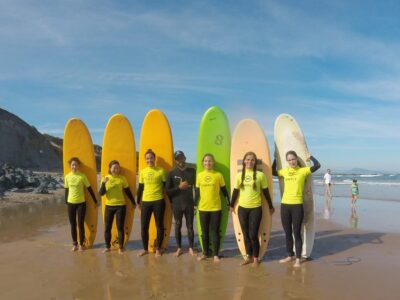
The best feature here is the small group size. Etienne limits lessons to five or six people, so you get more direct correction than you would at a large beach school. The lesson starts with safety and wave theory, then moves from body surfing to standing on a board.
I like the clear progression and the fact that boards and wetsuits are included. I also like that Etienne has helped first-timers stand up during the first two-hour class, while still taking time to explain currents and safe surfing areas. The main thing to watch is timing: the two hours include changing, walking to the beach, and instruction on the sand, so actual time riding waves may be closer to 75 to 90 minutes.
Key points for your first Basque Coast lesson
- Groups of five or six maximum: You receive closer attention than in a large commercial class.
- Meet at Plage du Centre in Bidart: The lesson is near Biarritz, but the stated meeting point is in Bidart.
- Etienne teaches the full beginner sequence: Expect safety, currents, body surfing, board balance, and standing technique.
- Boards and wetsuits are included: You do not need to arrange the main equipment separately.
- The two-hour schedule includes preparation: Changing, beach access, sand instruction, and packing are part of the total time.
- Tide and weather affect the schedule: Beginner lessons are planned for safer low-tide conditions, and poor weather can lead to a new date or refund.
A small-group introduction to surfing near Biarritz
This lesson is designed for someone who wants a real first lesson, not simply a board rental and a quick push into the foam. The setting is Plage du Centre in Bidart, on the Basque coast a short distance from Biarritz. You meet there, receive your equipment, and finish back at the same place.
Etienne’s method begins with the basics that can be easy to skip when a school is trying to move a large class through the water. You learn where it is safe to surf, what hazards to watch for, and how currents affect the beach. That preparation matters. A beginner needs to know where to stand and where not to go before worrying about style.
The group limit of six is a genuine advantage. Surf lessons are physical and fast-moving, and a teacher can only watch so many boards at once. In a smaller group, Etienne has a better chance of seeing your balance, correcting your position, and helping you attempt another wave without a long wait.
The price is listed at about $65.53 per person, which is reasonable for a two-hour beginner class with the board and wetsuit supplied. It is not the cheapest possible way to touch a surfboard, but it offers more instruction than a basic rental. The value depends on what you want: if you only need equipment, this is more than necessary; if you want to learn safely and get personal help, the price makes better sense.
More Beginner Surf Lessons in France:
- Legian Beach, Bali: Beginner or Intermediate Surf Lessons
★ 4.9 · 1,019 reviews - Maui: Two Hour Beginner Group Surf Lesson in Kihei
★ 5.0 · 950 reviews - Uluwatu: Beginner & Intermediate Surf Lesson with Equipment
★ 4.9 · 832 reviews
Meeting at Plage du Centre in Bidart
Pay attention to the location when you book. The experience is promoted as surfing in the Biarritz area, but the meeting point provided is Plage du Centre, 64210 Bidart. That distinction matters because Bidart and Biarritz are separate places, and you do not want to arrive at the wrong beach with a wetsuit bag in hand.
The meeting point is near public transportation, although no specific route or stop is provided. You should check the day’s transport details before leaving. The activity ends at the same meeting point, which keeps the arrangement simple.
Once you arrive, allow time to change and get down to the sand. The supplied timing indicates that changing and walking to the beach can take around 15 minutes before the lesson begins. That is normal for a surf class, but it explains why the entire experience lasts two hours while the water session is shorter.
The operator provides boards and combinations, with combinations meaning wetsuits. Lunch and soft drinks are not included, so plan those separately. For a short lesson, the included equipment is the important part. You do not need to spend extra money renting a board and wetsuit before the class.
First comes beach safety, not standing up
The opening section covers the place, the hazards, and the areas where you can surf safely. You then get an explanation of currents and how waves work. This may sound like classroom time when you are eager to reach the water, but it is useful instruction for anyone who has not surfed before.
Currents can change how easily you return to shore and where you end up in relation to the group. Wave shape also affects your chance of success. A beginner who understands where a wave is breaking has a much better start than someone who simply paddles at every swell.
The lesson also covers water safety rules intended to reduce accidents. That is especially important in a group setting, where boards, swimmers, and breaking waves share the same space. You should listen carefully here, even if you are keen to get moving. A few minutes of clear rules can save a lot of confusion later.
The schedule may change with the tide. Etienne explains that beginner instruction needs to take place at low tide for safety, and the daily tide does not match a fixed booking timetable months in advance. This can result in a time change. One booking was moved from morning to afternoon because of the tide, and a later request to move it again was not possible for the customer’s schedule.
That is a practical warning. Keep some flexibility around the lesson, especially if you are making a short visit to the Basque coast. A tide-based change may be necessary, but it can still disrupt a tightly packed day.
Body surfing gives you a feel for the waves
Before using the board, you warm up in the water with body surfing. This is a smart part of the lesson because it lets you feel the conditions without also managing a long board under your arms.
You begin to notice how the water moves, how a small wave lifts you, and when to let it carry you toward shore. You also get a first look at the actual conditions instead of relying only on the earlier explanation. For a nervous beginner, this can make the next stage less intimidating.
Body surfing is also a useful reminder that surfing begins with the wave, not with the board. You need to recognize the push of the water before you can use it to move a board. The warm-up connects the safety discussion on the beach with the practical work in the water.
After this, Etienne explains the techniques used to start on a wave. The focus is not on advanced turns or speed. It is on the first essential sequence: position yourself, catch the wave, keep your body extended, and then rise at the right moment.
More Surf Lessons around France:
- Biarritz : Cours de surf sur la côte Basque.
★ 4.6 · 54 reviews - Biarritz: 1.5-Hour Group Surf Lesson
★ 4.9 · 46 reviews - Biarritz: Surf lessons on the Côte des Basques beach
★ 4.9 · 45 reviews - Surf school Soonline Moliets
★ 4.5 · 27 reviews
Learning balance on the sand and in the water
The program includes elongated balance in the water and practice straightening on the sand. These two steps address the part of surfing that frustrates most first-timers: getting from lying down to standing without losing the wave.
Practicing the movement on the sand gives you a chance to understand the order of actions before the board is moving. You work out where your hands and feet go, and how to bring your body up without twisting the board. Then the water practice adds the harder parts: timing, balance, and the movement of the wave.
The sand practice may feel repetitive, but it is one of the most useful parts of a beginner lesson. You do not want to invent the movement while a wave is already carrying you. Rehearsing it first helps you act quickly when the moment comes.
A five- or six-person group also helps here. Etienne can watch whether you are moving too early, placing your feet poorly, or trying to stand before the wave has enough power. A larger class often means waiting for a quick turn and receiving only broad advice.
One customer who had taken surf lessons before found the instructions faster and clearer with Etienne, and was able to stand on the board during the first class. That is not a promise that everyone will stand up, since conditions and fitness vary, but it does show where this lesson puts its effort: direct coaching and early progress.
What two hours really means
You should read the duration as a total activity time, not two full hours on the board. A typical outline is about 15 minutes to change and reach the beach, around 15 minutes of theory on the sand, roughly 75 minutes in the water, then time to return and change again.
That works out to about one hour and 15 minutes of surfing, though the provider also describes a water session closer to 90 minutes in one detailed explanation. The exact amount may depend on the group, tide, beach conditions, and how quickly everyone gets ready.
This is not unusual for a surf class. The instructor has to explain the conditions, fit equipment, keep the group safe, and bring everyone back together. Still, you should know what you are paying for. If you expect two uninterrupted hours of riding waves, you may feel shortchanged. If you see the booking as a complete beginner session with preparation and instruction, the duration is more reasonable.
The physical effort also matters. Surfing asks you to paddle, push up from the board, balance, and repeatedly walk through moving water. The activity requires a moderate level of fitness. You should be comfortable with physical activity in the water and ready to follow safety instructions.
Language, organization, and the practical details
Instruction is offered in English. Do not assume that a booking in another language will be available. One customer reserved a Spanish-language class and ended up taking the lesson in English after learning that Etienne’s Spanish was limited. Communication worked, but the language did not match the original booking.
The same booking also involved several time changes. The first change was linked to the tide, while another request came shortly before the class. This shows why you should check messages and keep your plans flexible. Tide-based scheduling is understandable for a beginner class, but it can be inconvenient if you are catching a train or leaving the area that day.
There was also one reported registration mix-up, with the provider initially forgetting a booking before placing the customers into another time. The teaching itself was described as helpful, but the organizational issue is worth keeping in mind. Confirm your time and meeting point before setting out, particularly if your schedule is tight.
These concerns do not erase the strengths of the lesson, but they are part of the decision. The instruction appears to be the stronger part of the operation. The scheduling side may require patience and quick replies.
Who will get the most from this lesson
This class suits a first-time surfer who wants more help than a rental desk can provide. It is also a good choice if you have tried surfing before but still struggle to catch a wave or stand consistently. The small group lets Etienne focus on individual problems rather than giving one speech to a large crowd.
You will likely appreciate it most if you value:
- Direct coaching instead of a large beach-school format
- A clear introduction to currents and water safety
- Equipment included in the price
- A lesson conducted in English
- A compact two-hour activity near Biarritz
- A chance to work on standing during the first session
It is less suitable if you need a guaranteed start time, a full two hours in the water, or instruction in Spanish. It may also be a poor fit if you have limited physical fitness or cannot adjust your plans for the tide.
The rating of 4.3 from seven reviews suggests a generally positive experience, but the small number of ratings means you should not treat it as a guarantee. The praise centers on Etienne’s welcoming manner, professional teaching, clear explanations, and ability to help beginners make visible progress. The complaints focus on communication, registration, schedule changes, and how the two-hour duration is counted.
Should you book the Bidart surf lesson?
Book this experience if you want a small, hands-on first surf lesson and can accept some flexibility around the schedule. The strongest reason to choose it is the five- or six-person limit, combined with Etienne’s step-by-step approach from safety briefing to standing on the board.
Before booking, make sure the Bidart meeting point works for you, keep time open around the scheduled hour, and confirm that English instruction suits you. Expect the full activity to last about two hours, with changing and beach instruction included. If those conditions fit your plans, this is a good-value way to meet the Basque coast from the water without taking on a large group class.
FAQ
Where does the surf lesson meet?
The meeting point is Plage du Centre, 64210 Bidart, France. The activity ends back at the same meeting point.
How long does the experience last?
The activity lasts approximately two hours in total. That time includes changing, walking to the beach, instruction on the sand, surfing, returning, and changing again.
How much time will I spend in the water?
The supplied schedule indicates roughly 75 to 90 minutes in the water, depending on the timing and organization of the session.
What equipment is included?
Boards and wetsuits are included.
Is the lesson offered in English?
Yes. The experience is offered in English. Spanish instruction is not guaranteed.
How many people are in each group?
The group is limited to a maximum of six people, with the stated preferred format being five or six participants.
Do I need to be physically fit?
You should have a moderate level of physical fitness. Surfing involves paddling, balancing, standing up on the board, and moving through the water.
Can I cancel for a full refund?
Yes. You can cancel at least 24 hours before the local start time for a full refund. If poor weather causes the operator to cancel, you will be offered another date or a full refund.
Latest surf sessions around France
- Surf school Soonline Moliets★ 4.5 · 27 reviews
- Surf lesson 1h30 South of Messanges★ 5.0 · 5 reviews
- 3 Hours of Surf and Electric Bike Exploration in Lacanau★ 5.0 · 8 reviews
- Discover Surfing on the beaches of Biarritz★ 5.0 · 3 reviews
- Classes DE Surf Collectif DE 1H30★ 5.0 · 2 reviews
- Surfing lessons★ 5.0 · 25 reviews
- Surf lessons on the mythical site of La Torche★ 5.0 · 19 reviews
- Porto-Vecchio: Jet Surf Course – Unique on the island★ 5.0 · 5 reviews
Biarritz Surf Lessons, compared.
Biarritz: Surf lessons on the Côte des Basques beach
Read our review →
Browse the lists this tour appears in