
Review · GRAN CANARIA
Playa del Inglés Maspalomas: High Quality Surf Classes
The best part of this Gran Canaria experience is that you do not need to arrive knowing anything about surfing. You begin beside the Maspalomas dunes with theory and video instruction, then move to a sandy beach where instructors stay close and help you catch your first waves.
I like the small-group coaching and the mobile format. The school can choose the beach with the best beginner conditions, rather than forcing every class onto one patch of water. I also like the useful extras: photos, water, fruit, insurance, and all your equipment are included. The catch is simple: surfing is hard work, and the four-hour session depends on the sea behaving.
Key points at a glance
- Start from zero: A theory class and video introduction explain the basics before you enter the water.
- Beach choice follows conditions: You may walk 10 to 20 minutes to Playa del Inglés or take included transport to another beach.
- Close help in the water: Instructors such as Julian, Marte, Jordan, and Danny focus on technique, safety, and getting you onto waves.
- Useful extras are included: Board, leash, rash vest, wetsuit, insurance, photos, water, and fruit come with the lesson.
- Expect a real workout: Paddling, standing, balancing, and repeated attempts can leave you tired, wet, and pleasantly sore.
- Best for active beginners: You need to swim, be reasonably fit, and be comfortable carrying a board across sand.
A four-hour first lesson beside the Maspalomas dunes
Surf Canaries gives you a proper introduction rather than simply handing you a board and pointing at the sea. You check in at the school at Alf. Provisionales, Anexo 2, in Playa del Inglés, close to the Maspalomas dunes.
The opening session takes place at the school. You learn how the board works, how to lie down and paddle, where to place your feet, and how to stand. Video examples make the early advice easier to picture. That matters because the first few minutes on a surfboard can feel confusing. A clear demonstration saves you from wasting energy on the wrong movement.
The four-hour booking covers the whole experience from instruction through water time. The exact start time can shift slightly, so keep your plans loose around the lesson. The school offers instruction in Spanish, English, French, and Italian.
The mood is friendly, but this is not a passive beach activity. You will spend much of the day moving, lifting, balancing, and getting wet. One useful lesson from past participants is to treat the class as a workout with waves, not as four hours of sitting in the sun.
More Surf Lessons around Gran Canaria:
- Puerto Rico, Gran Canaria: boat trip, drinks, food, paddle surfing, snorkeling
★ 4.6 · 310 reviews - Gran Canaria Maspalomas: Surf lessons all levels
★ 5.0 · 197 reviews - Small-Group Surf Lessons in Gran Canaria
★ 5.0 · 138 reviews
Choosing the right beach for the day
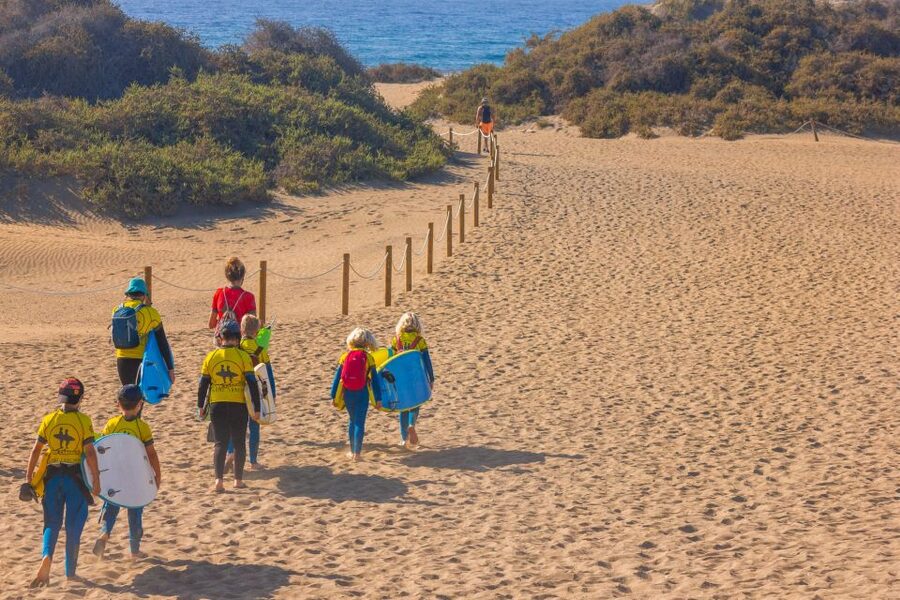
Surf Canaries works as a mobile school. If the best beginner waves are at Playa del Inglés, you walk there with your board. The walk takes about 10 to 20 minutes, depending on where the waves are breaking, and crosses the sand near the dunes.
That beach setting is part of the appeal. You are not being sent straight into a complicated rocky break. A sandy shore is a friendlier place for first attempts, and one past participant noted that the waves could be reached without a long paddle out.
If another beach has better conditions, transport is included. This gives the instructors room to respond to the sea instead of sticking rigidly to one location. It also means your exact beach is not guaranteed in advance, and the day may feel less predictable than a fixed-location lesson.
The walk with a board is manageable for most people in reasonable shape, but do not ignore it. Carrying equipment over sand takes more effort than walking on a pavement. If you have low fitness, back trouble, or simply dislike physical exertion, this is worth considering before you book.
Getting into the water with Julian, Marte, Jordan, or Danny
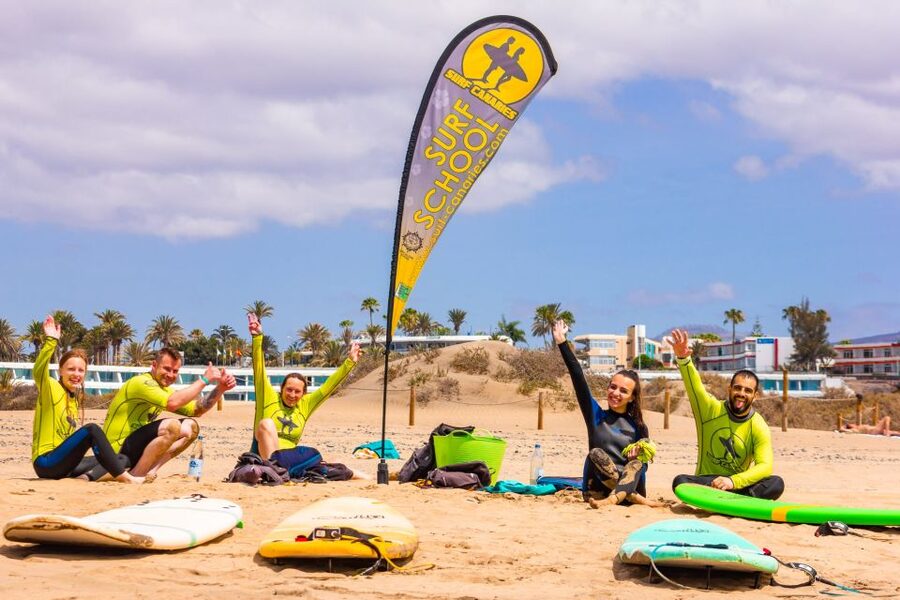
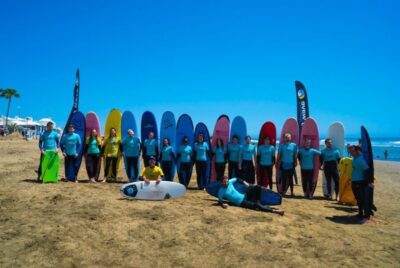
Once you reach the beach, the instructors divide their attention according to ability. A mixed group may include people who have tried surfing before and people who have never stood on a board. When that happens, one instructor can work with the more experienced participants while another concentrates on beginners.
That arrangement is valuable because a first lesson has two competing needs. You need repeated practice, but you also need correction before bad habits settle in. The instructors stay in the water and help with wave selection, timing, body position, and standing technique.
The named instructors praised in the supplied feedback include Julian, Marte, Jordan, and Danny. Julian is noted for patience and motivation, including during a cold-weather session. Jordan gave practical tips that helped one beginner improve. Marte and Julian led a family lesson that helped a parent and teenage sons get onto the board. Danny is described as an enthusiastic teacher who gave attention to each person in the group.
The strongest pattern is not one flashy trick. It is close, calm support. Instructors explain the movement simply, then give you another chance. That is exactly what a beginner needs, since your first successful stand may come only after several unglamorous wipeouts.
What your first wave will really feel like
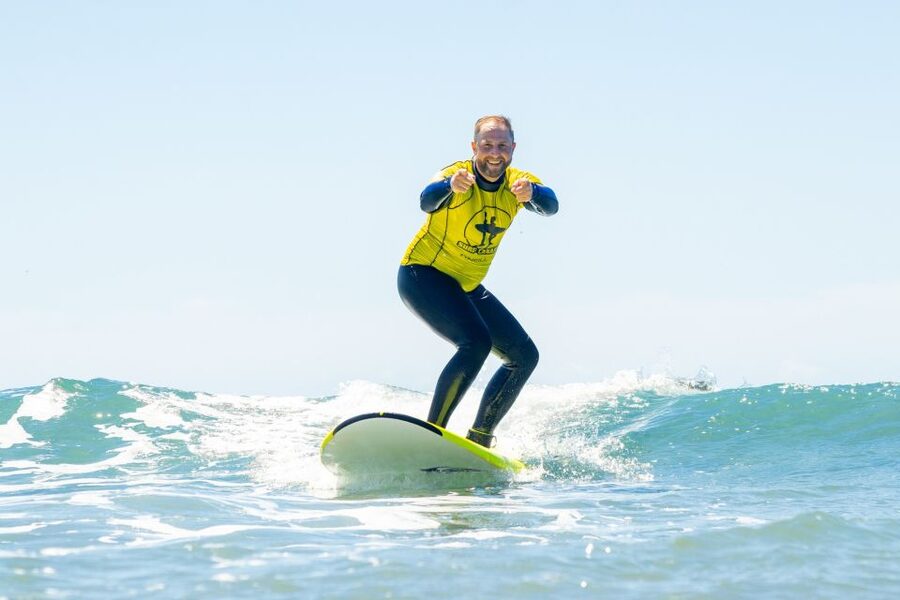
The school aims to help beginners stand on the first day, and the conditions are chosen with that goal in mind. You should see this as a realistic target, not a promise that every person will ride a long wave.
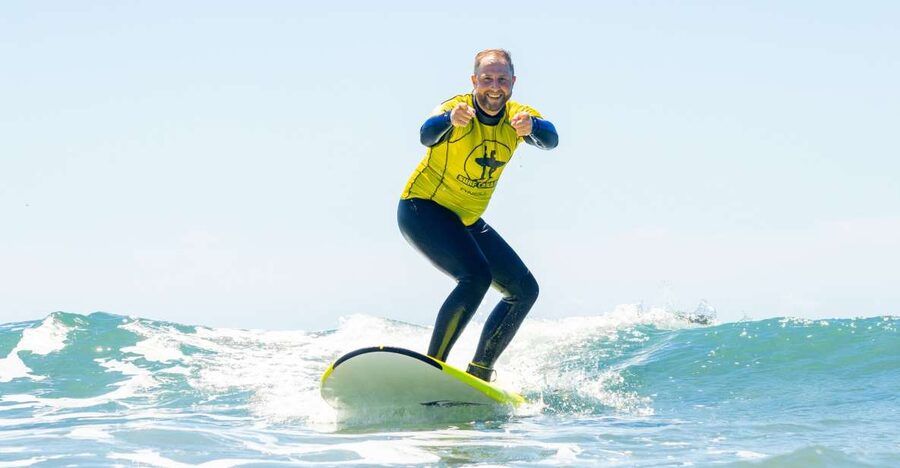
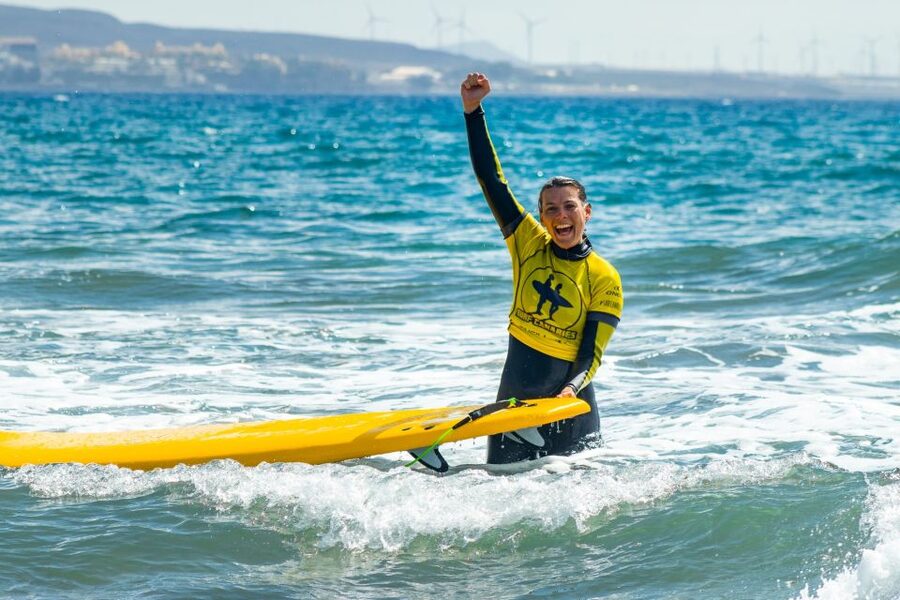
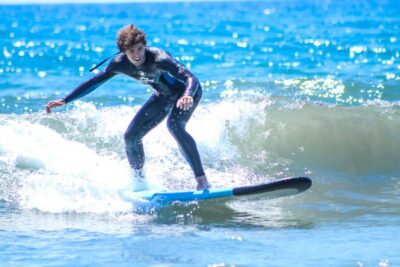
The first success may last only a few seconds. You lie on the board, paddle, push up, bring your feet underneath you, and try to keep your weight centred. The board may wobble. You may stand too early, too late, or with your feet in the wrong place. That is normal for this sport.
The instructors make the process less frustrating by giving direct help in the water. You do not have to remember every point from the theory class at once. The practical coaching turns abstract advice into small changes you can test immediately.
I like that the session is long enough to give you several attempts. A short taster can leave you just as you begin to understand the timing. Four hours gives you room to learn, rest briefly, drink water, and try again. It also explains why the activity can feel tiring by the end.
The sea remains in charge. Surf conditions may be gentle and ideal for beginners, or less cooperative. The school’s mobile setup helps, but no instructor can guarantee perfect waves on every date. If your main goal is a guaranteed stand-up photograph, keep your expectations modest. If your goal is to learn the basics and have a lively day outside, the odds are much better.
Same water, another way to ride it:
- Playa del Inglés surf lessons
★ 4.8 · 121 reviews - Gran Canaria: Maspalomas Surf Lessons
★ 4.6 · 113 reviews - Premium Surf Course in Gran Canaria
★ 5.0 · 89 reviews - Gran Canaria Surf Lessons: Playa del Inglés & Maspalomas
★ 4.8 · 76 reviews
Equipment, comfort, and the practical extras
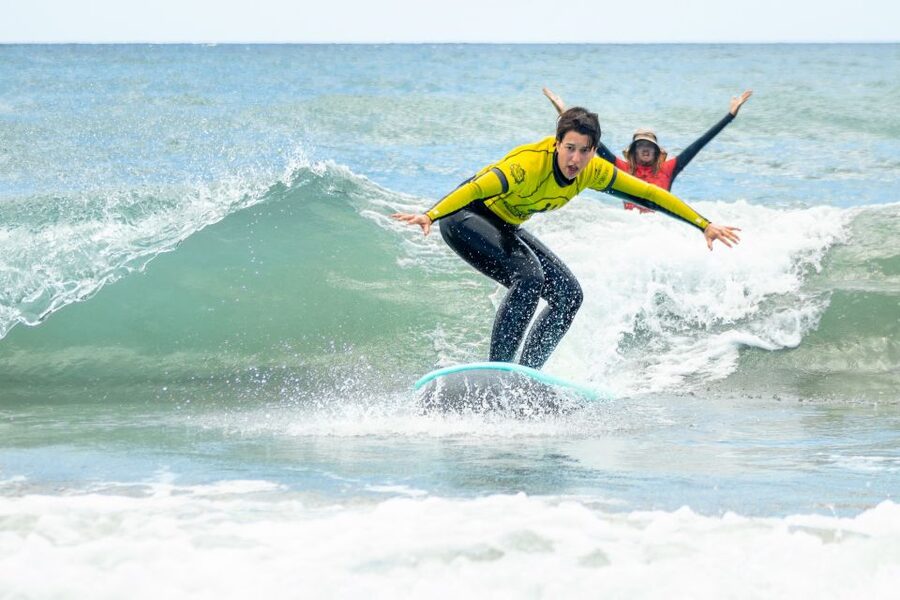
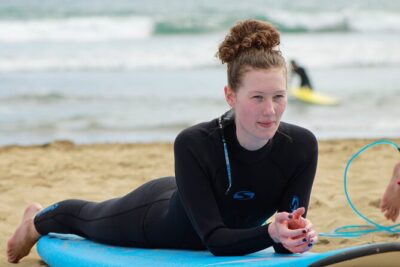
You receive the main equipment: a surfboard, leash, rash vest, and either a long or short wetsuit. Having the wetsuit included removes one common source of hassle, especially if you are flying into Gran Canaria and do not want to pack bulky gear.
You should bring swimwear, a towel, sunscreen, and a hat. Bring your passport or identity card, or a copy. Water and a piece of fruit are provided after the first session, which is a small but welcome touch after physical effort.
Photos of you surfing are included at no extra charge. This is more useful than it may sound. Your first lesson moves quickly, and you may not have a free hand for a phone. The photos give you a record of the experience and let family or friends see what you were doing in the water.
One participant also noted that a backpack was available for belongings. The supplied information does not promise this as a standard inclusion, so I would not rely on it without checking. Keep your valuables to a minimum and follow the school’s instructions for personal items.
A 10 percent shop discount is included as well. It may appeal if you decide that one lesson was enough, but you want a cap or another small surf item. It should be treated as a bonus, not a reason to book.
Why the price can make sense
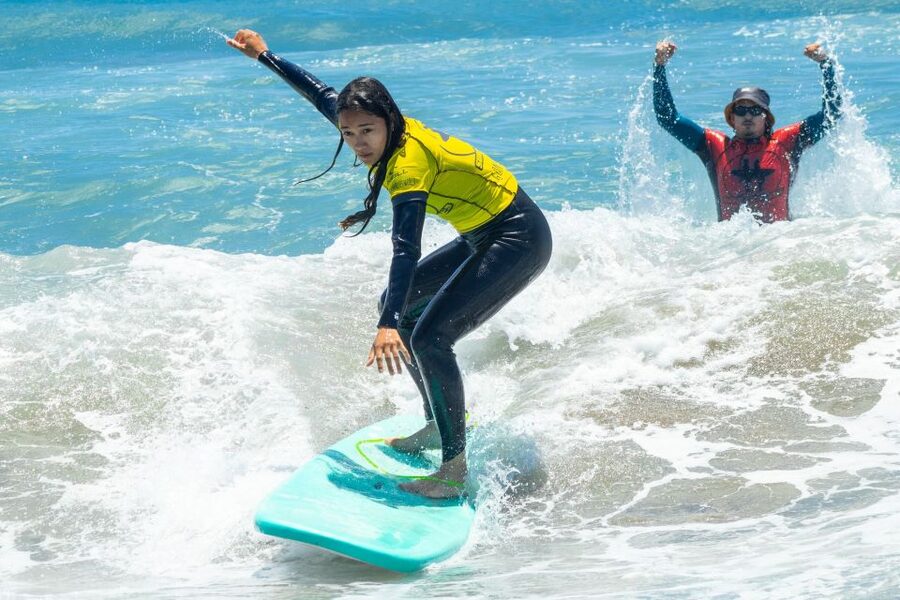
At $63 per person, this is not the cheapest way to spend a morning at the beach. The price makes more sense when you count what is bundled into the four hours: instruction, surfboard, leash, rash vest, wetsuit, insurance, water, fruit, photographs, and possible transport to another beach.
The small-group format is the key value. You are paying for access to instructors who can watch your technique and help you catch waves, not just for rental equipment. A cheap board rental would leave you to judge the waves and safety on your own. That may suit an experienced surfer, but it is poor value for a first-timer.
Private and small-group options are available. A private session should appeal if you want highly focused coaching, while a small shared class may offer a more relaxed and social feel. The exact group size is not stated, so ask if the number of participants matters to you.
The free photos also improve the value for families and couples. You do not have to pay separately for a photographer, and the school can capture the moments when you are actually riding.
Fitness, age, and who should skip it
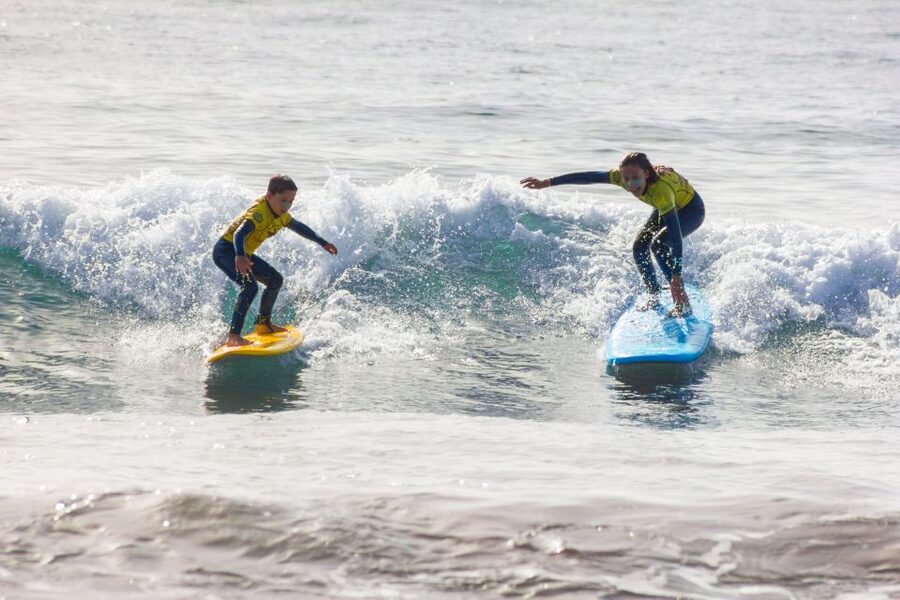
The minimum age is eight. Children who can follow instructions and swim may enjoy the class, but an adult should judge a child’s confidence in open water and ability to manage a board. A lesson with a 10-year-old son and another with children aged 10 and 13 worked well, according to the supplied details.
You need to be a swimmer. The activity is not suitable for non-swimmers, pregnant women, wheelchair users, people with back problems, or anyone with a low level of fitness. There is also a maximum weight of 243 pounds, or 110 kilograms.
Those limits are not minor footnotes. You may need to carry a board, walk over sand, paddle, push yourself up repeatedly, and recover after falling. One fit 61-year-old found the lesson fun and exhausting, with a few bruises to show for it. That is a useful picture of the day: age alone is not the deciding factor, but fitness and comfort in the water matter.
Wear sunscreen before you arrive, then reapply as needed. A hat is useful before and after the water, though it will not stay on your head while surfing. Bring a towel and dry clothes for afterward.
The safety side of a beginner surf lesson
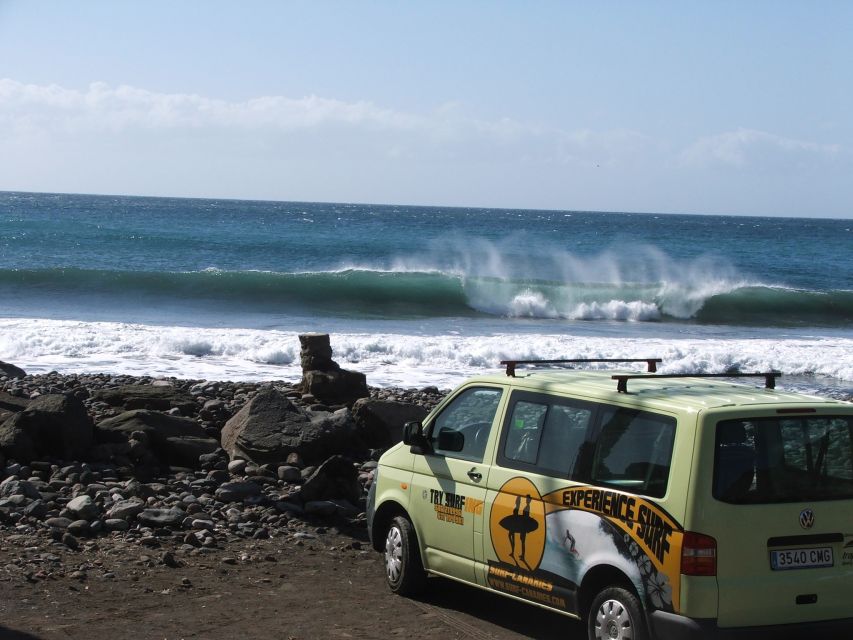
The activity includes third-party and accident insurance. More important in practice, instructors remain involved in the water rather than ending their help after the beach demonstration.
You still need to listen carefully. Surfing has moving boards, changing waves, and other people sharing the water. Keep your leash attached, follow instructions about where to position yourself, and do not paddle into a wave without knowing who has priority.
The school’s safety approach is part of the reason this works for first-timers. You get an explanation before entering the water, equipment suited to the lesson, and hands-on correction when you are trying to stand. That does not remove every risk, and the school clearly warns that the experience is physical.
Conditions can also change. The starting time may vary slightly, and the surf day depends heavily on the sea. A flexible attitude helps. The best lesson may not match the exact plan you imagined when booking.
What the experience feels like for families and mixed abilities
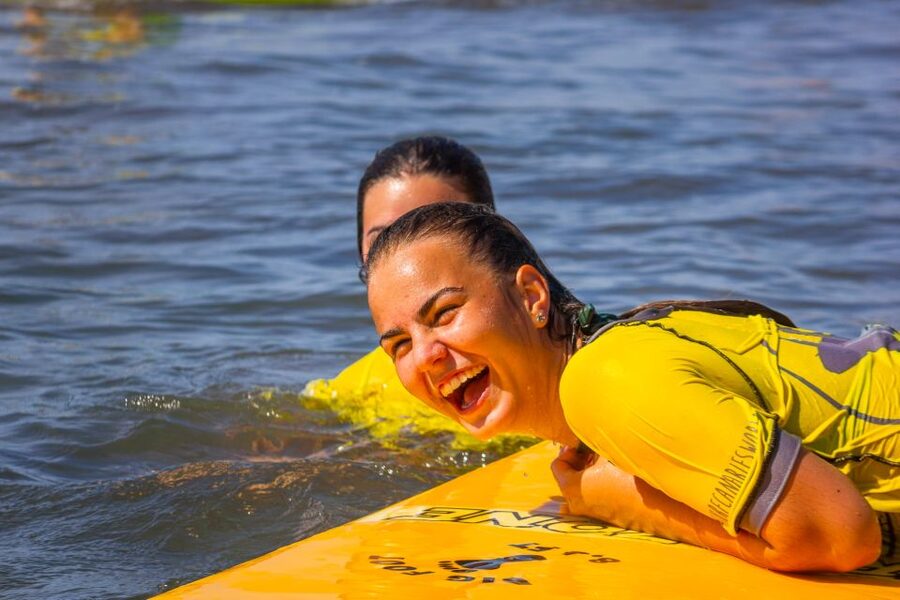
This can work well for a family, couple, or group of friends with different levels. Beginners receive basic coaching, while people with some past experience may get advice on improving their technique.
The family examples are encouraging because the lesson is not limited to young, athletic adults. A parent and teenage sons managed to surf, and children as young as 10 took part in successful first lessons. Still, everyone must meet the swimming, fitness, age, and health requirements.
For a mixed group, ask about the small-group arrangement when you book. The instructors may split attention by ability, which prevents experienced participants from holding back and stops beginners from feeling rushed.
The atmosphere is described as fun and motivating, but the work remains real. You may laugh at your own falls, cheer when someone stands, and finish tired. That shared effort is part of the social appeal.
Booking details that affect your decision
You meet at Surf Canaries Surf School at Alf. Provisionales, Anexo 2, Playa del Inglés. The experience lasts four hours, though the starting time may vary slightly, so avoid scheduling another fixed activity immediately afterward.
You can cancel up to 24 hours before the activity for a full refund. The reserve-now, pay-later option lets you hold a place without paying immediately, which helps if your Gran Canaria plans are still shifting.
The school offers Spanish, English, French, and Italian instruction. Private or small-group formats are available. Ask about the group setup if personal coaching is your top concern.
The 4.9 rating from 363 reviews points to a consistently strong experience, but you should still read the conditions carefully. Surfing is not a sightseeing stop where you can remain dry if you change your mind. You are committing to a physical class in the ocean.
Should you book Surf Canaries?
Book this if you want a genuine first attempt at surfing, you can swim, and you are ready for a workout. The combination of theory, video, small-group coaching, beach flexibility, equipment, insurance, and free photos makes $63 a fair price for a full lesson.
I would especially choose it for active families, couples, and solo visitors who want more than sunbathing. The instructors’ patient style and the chance to stand on the first day make it approachable, even if you have never touched a surfboard.
Skip it if you have back problems, low fitness, cannot swim, or want a guaranteed calm schedule. Also think twice if carrying a board over sand sounds unpleasant. For everyone else, pack your swimsuit, accept that the first attempts may be messy, and enjoy the rare holiday activity where falling down counts as progress.
FAQ
Where does the surf lesson meet?
You check in at Surf Canaries Surf School at Alf. Provisionales, Anexo 2, Playa del Inglés.
How long does the experience last?
The surf experience lasts four hours.
Do I need previous surfing experience?
No. The class is designed for beginners and includes a theory session and video introduction before you enter the water.
Is transport to the beach included?
Yes. Surf Canaries is a mobile surf school, so transport is included if the best conditions are at another beach. If the best waves are at Playa del Inglés, you walk there with your board.
How long is the walk to Playa del Inglés?
The walk takes about 10 to 20 minutes, depending on where the waves are breaking.
What equipment is provided?
You receive a surfboard, leash, rash vest, and a long or short wetsuit. Surf instruction and insurance are also included.
Are photos included?
Yes. Photos of you surfing are included at no extra charge.
What should I bring?
Bring a hat, swimwear, towel, sunscreen, and your passport or identity card. A copy of your passport or identity card is accepted.
Can children take part?
Children under eight cannot take part. Participants aged eight and older must also be swimmers and meet the fitness and health requirements.
Who should not book this activity?
The activity is not suitable for non-swimmers, pregnant women, wheelchair users, people with back problems, people with a low level of fitness, or anyone over 243 pounds, or 110 kilograms.
Latest surf sessions around Gran Canaria
- Paddle Surf SUP at Anfi Beach★ 4.0 · 12 reviews
- Pack 2 People Surf Course in Playa del Inglés and Maspalomas★ 5.0 · 2 reviews
- Surf lessons in Las Canteras Beach★ 4.8 · 19 reviews
- San Agustín Surf lessons★ 4.5 · 10 reviews
- Las Palmas de Gran Canaria: Group surf lessons on La Laja beach★ 4.9 · 27 reviews
- Las Palmas: Learn to Surf with a Special Price for Two Group★ 4.8 · 30 reviews
- Gran Canaria: Meloneras Beach Surf Lesson★ 5.0 · 5 reviews
- Gran Canaria Playa del Ingles: Surf lessons all levels★ 4.7 · 11 reviews
Gran Canaria Surf Lessons, compared.
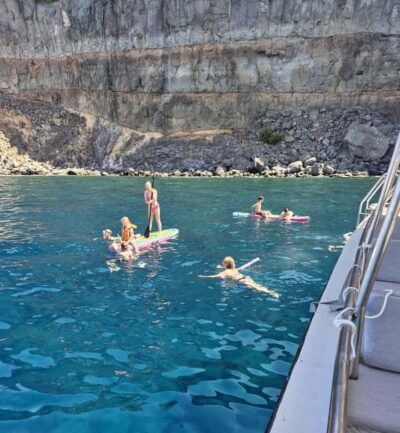
Puerto Rico, Gran Canaria: boat trip, drinks, food, paddle surfing, snorkeling
Read our review →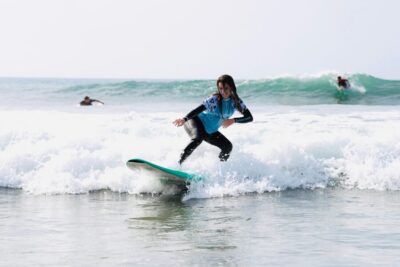
Gran Canaria Maspalomas: Surf lessons all levels
Read our review →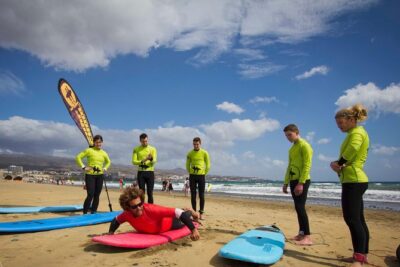
Gran Canaria Surf Lessons: Playa del Inglés & Maspalomas
Read our review →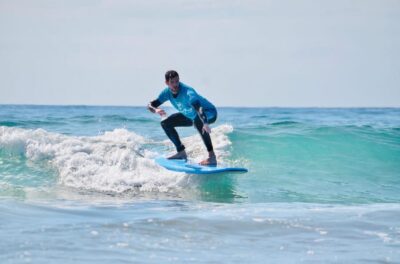
Las Palmas: Learn to Surf with a Special Price for Two Group
Read our review →Browse the lists this tour appears in