
Review · AUSTRALIA
Noosa Heads – 2-Hour Surf Lesson with Expert Instructors
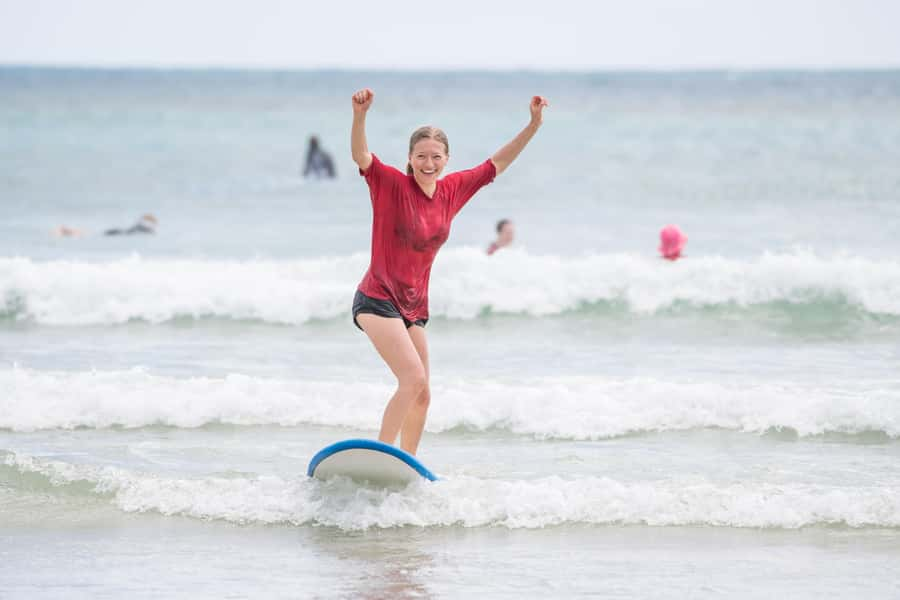
Noosa’s North-facing Main Beach gives first-time surfers a friendly place to meet the ocean. The water is warm, the waves are generally gentle, and your coach stays close enough to help push you onto the first useful waves. This is less about watching a demonstration from shore and more about getting you standing on a board before the lesson ends.
I like two things right away: small groups capped at seven and a strong focus on ocean awareness. Coaches explain rips, currents, and safe positioning before you paddle out, then offer personal advice in the water. I also like that the soft boards, rash vest or wetsuit, sunscreen, storage trailer, and shower are included in the $57 price.
The main drawback is the parking and timing. Noosa is busy, especially in peak tourist periods, so you are told to arrive 15 minutes early and allow at least another 30 minutes to find a car space. The lesson itself lasts two hours, but your morning needs a wider time window.
Key points to know before you book
- Small groups of up to seven: You get more direct coaching than in a large beach class, with room for individual tips.
- A protected North-facing beach: Noosa Main Beach offers warm water and manageable waves for learning basic surfing.
- Former champions lead the school: The program is guided by a former World and Australian Champion and a team of qualified local coaches.
- Safety comes before the first wave: You learn to identify rips, currents, and changing beach conditions before heading into the water.
- Soft boards and beach gear are supplied: A rash shirt or wetsuit, soft surfboard, sunscreen, storage, and a shower are included.
- Younger children can join: The minimum age is seven, though pregnant women and children under seven should not take part.
Why Noosa Main Beach works for first-time surfers
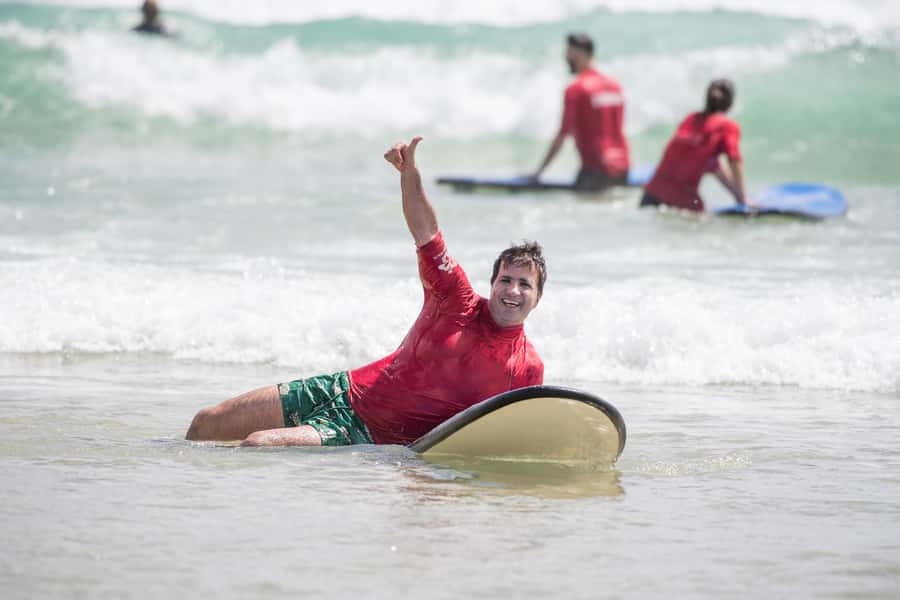
Noosa is famous for surfing, but that does not mean every part of the coast is suited to beginners. This lesson takes place at Main Beach, where the North-facing shore and generally gentle waves create a calmer setting for learning the basics.
That matters because your first surf lesson is often a battle with several new sensations at once. You are balancing on an unstable board, judging moving water, remembering where to place your hands, and trying to stand before the wave passes. A beach with a more forgiving feel gives you a better chance to think clearly.
You will not be left to figure out the ocean alone. The opening instruction covers rips and currents, along with basic awareness of where and how to enter the water. I value this part because it teaches a skill you can use beyond this two-hour session. Catching a wave is fun, but knowing when and where to do it is more important.
Conditions still change. Gentle waves do not mean effortless waves, and your success can depend on the day’s surf. The school presents Noosa as a safe, protected place to learn, but you should still expect to work hard, fall off, and need several attempts before the board feels natural.
More Two-Hour Experiences in Australia:
- Bondi Beach: 2-Hour Surf Lesson Experience for Any Level
★ 4.9 · 935 reviews - Byron Bay: 2-Hour Small Group Surf Lesson
★ 4.8 · 657 reviews - Noosa Heads: 2 Hour Surf Experience on the Sunshine Coast
★ 4.9 · 644 reviews
Meeting at the red surf trailer
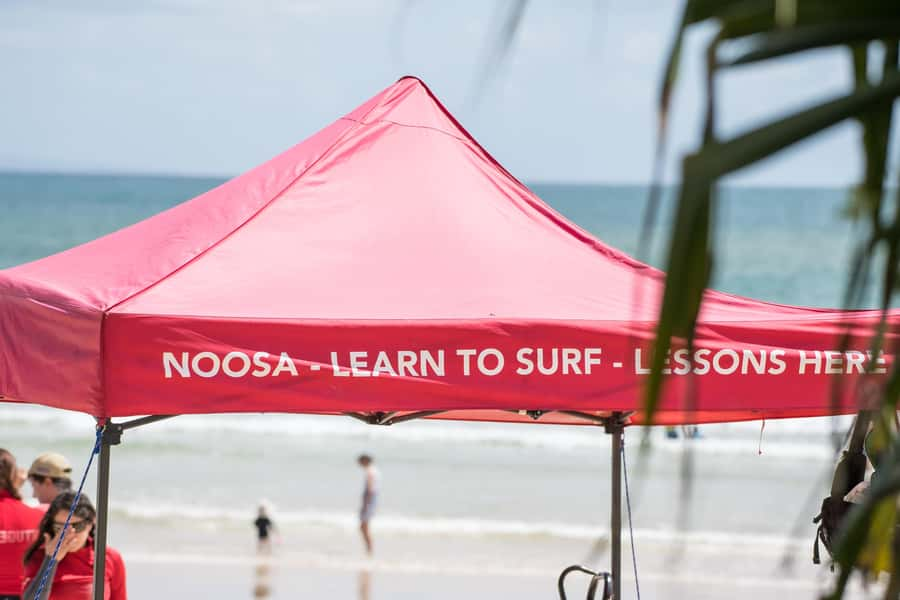
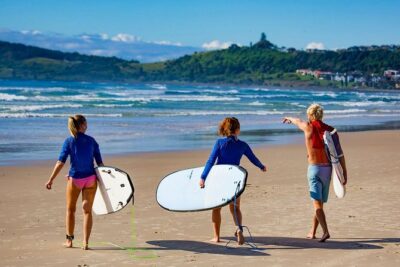
The starting point is Merrick’s Noosa Learn to Surf at the car park by Beach Access 14 on Claude Batten Drive. Look for the red surf trailer. You should arrive at least 15 minutes before your booked start time.
The location is easy to miss if you are rushing, and finding a car space can take much longer than the walk to the beach. In the busy tourist season, allow at least 30 minutes for parking. That advice is worth taking seriously. Arriving late cuts into the part of the lesson you paid for and may leave you starting in a fluster.
At the trailer, you sign in and receive your equipment. The school provides a soft surfboard and a protective rash shirt or wetsuit, depending on what is appropriate for the conditions. You can place personal items in the lock-up trailer, which means you do not need to carry valuables down to the sand.
Bring swimwear and a towel. Sunscreen and a post-lesson shower are supplied, but food and drinks are not. I would eat and hydrate before you arrive, especially if you plan to spend more time at the beach afterward.
The short walk and the first safety briefing
Once you have your board and protective top, you walk down the pathway to the beach. The route is not described as a long transfer, and one family found the board walk manageable, but carrying even a soft board is more awkward than walking empty-handed.
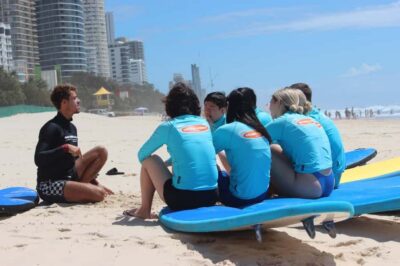
On the sand, your coach explains the basic parts of the lesson. You learn how to handle the board, where to place your hands, and how to move from lying down to standing. The safety briefing also covers rip and current identification, giving you a simple framework for reading the beach.
This is where the lesson earns more than a quick photo opportunity. A weak surf class can rush straight into the water and leave beginners confused. Here, the beachside instruction gives you a chance to rehearse the movement before waves and other surfers compete for your attention.
The coaches use clear, practical directions. James, Anthony, Oa, Mike, Finn, Sol, Saul, Dylan, and other team members have been praised for being patient and encouraging, though the coach assigned to you will depend on the day. The repeated pattern is useful: explain the movement on shore, let you try it in the water, then offer a small correction rather than burying you in theory.
Waist-deep practice before the real wave
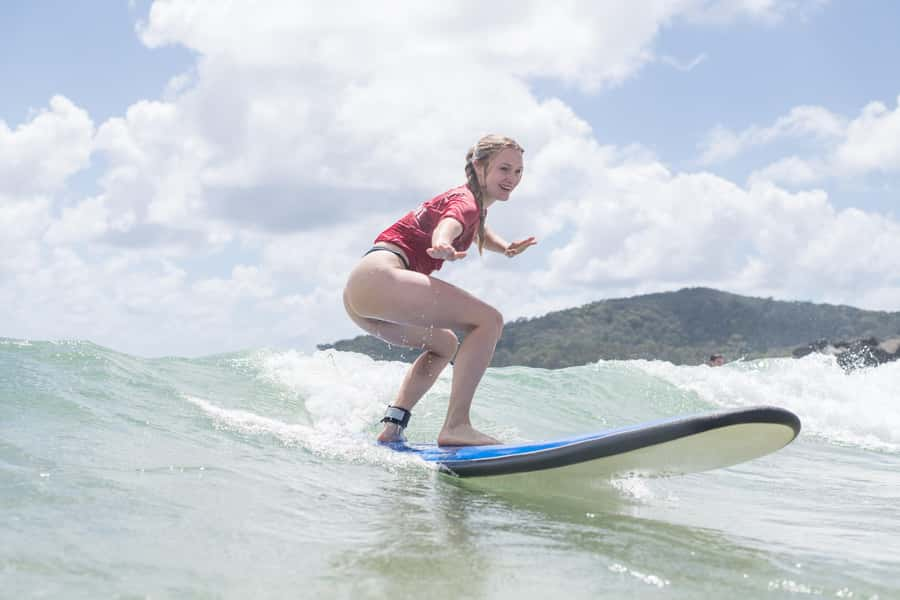
The first water work takes place in roughly waist-deep water. This is a sensible progression. You can feel the board move under you without immediately dealing with deeper water, stronger push, or the pressure of a fast wave.
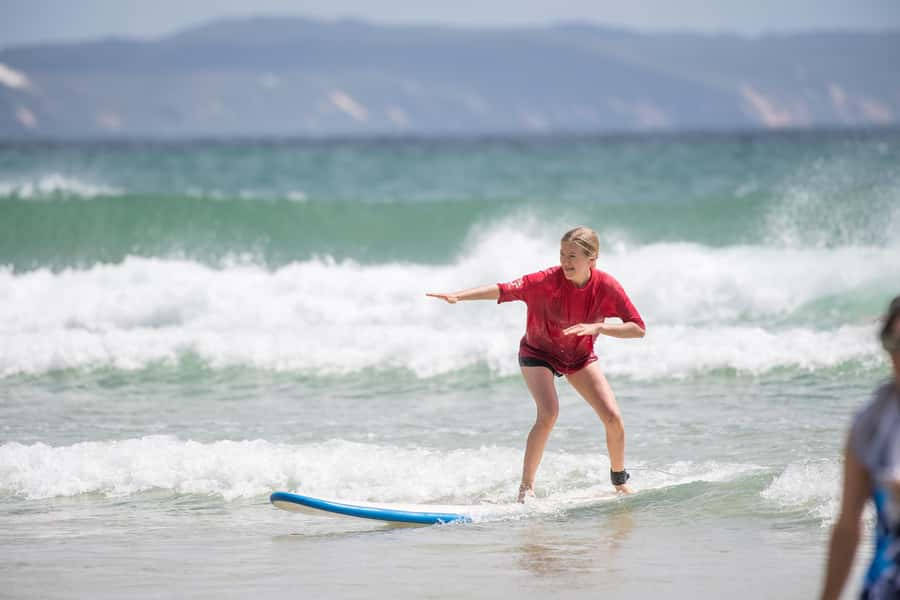
Your coach helps you catch initial waves and gives instructions on when to paddle and when to rise. The standing technique is broken into manageable steps. You lie on the board, place your hands correctly, bring your feet underneath you, and try to rise into a stable position.
Do not expect every attempt to work. Your first successful stand may last only a moment, and that is still progress. The point is to build a repeatable movement. Once your timing improves, the coach can help you try again with a better wave.
The group size matters here. With no more than seven participants, a coach can watch your body position and offer a specific fix. You may be told to move a foot, look ahead, adjust your hands, or wait for a better wave. Those small corrections are often more useful than another general explanation.
Groups can include different ages and skill levels. A 10-year-old, a 14-year-old, and an adult family member have all taken part together, while some groups include complete beginners alongside someone with a little prior experience. The teaching is adjusted to the person, rather than forcing everyone through an identical pace.
More Surf Lessons around Australia:
- Learn to Surf at Noosa on the Sunshine Coast
★ 5.0 · 277 reviews - Surfing Lessons on Sydney’s Bondi Beach
★ 5.0 · 267 reviews - 2 Hour Ultimate Learn to Surf Adventure
★ 5.0 · 235 reviews - Half Day Surf Lesson
★ 4.5 · 234 reviews
Catching your first wave with help from the coach
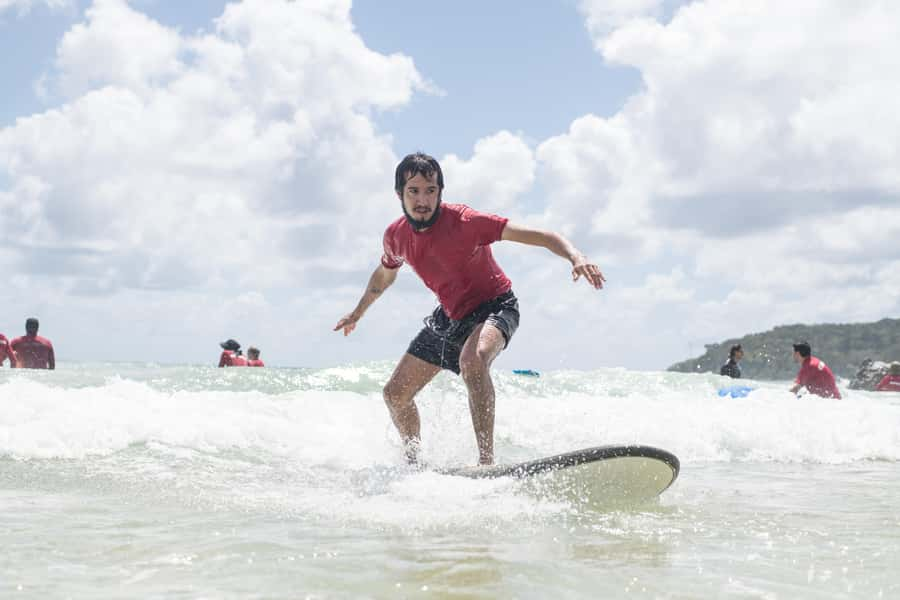
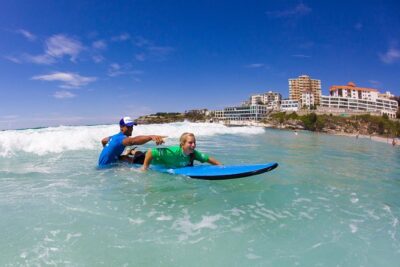
The best part comes when you stop practicing the movement and start riding. Your instructor can help by pushing the board into a suitable wave, then giving advice as you try to stand. That push is not a shortcut that removes the learning. It gives you the speed and timing needed to feel what a ride is supposed to be like.
For a beginner, the first wave is often the moment the lesson makes sense. Until then, surfing can seem like a collection of strange instructions. Once the board moves and you stay upright, even briefly, you understand why people keep returning to the water.
Many participants have managed to stand during their first lesson, including people who had never surfed before. That is a realistic goal, not a guarantee. Your result will depend on surf conditions, fitness, balance, timing, and how comfortable you feel in the water.
The coaching style is encouraging without turning the session into a contest. Coaches such as Anthony, Oa, Mike, James, and Finn have been singled out for calm explanations, patience, humor, and personal feedback. That matters if you are nervous. A coach who keeps instructions clear and gives you another attempt after a fall can make the difference between frustration and a useful first day.
You should also expect some surf culture along the way. One participant appreciated the encouragement mixed with a little local surf flavor. That adds character without taking the lesson away from its main purpose: learning safely and getting you onto a wave.
What the two-hour format gives you
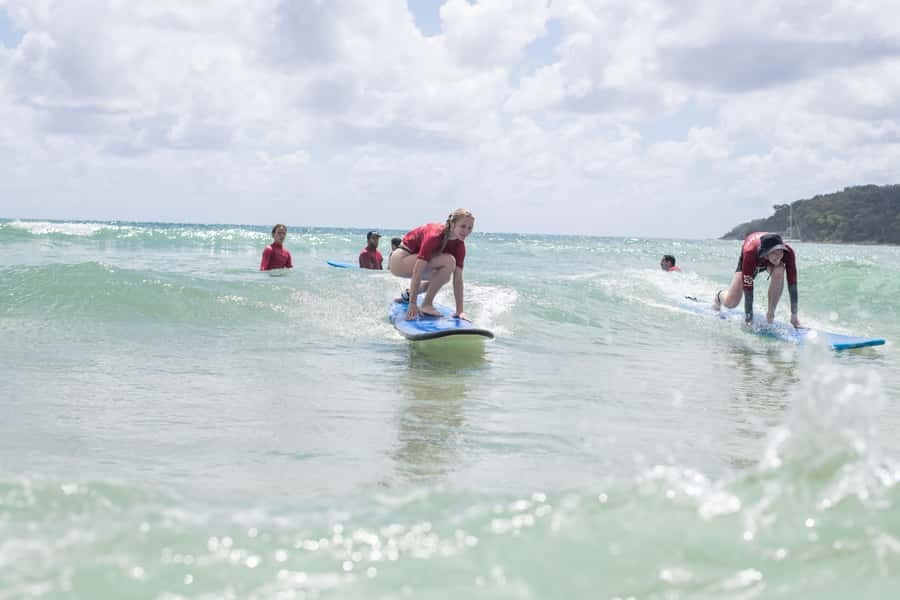
Two hours is a good length for a first lesson. You have time for the briefing, the beach instruction, equipment handling, waist-deep practice, and repeated attempts in the water. A shorter session could feel rushed, while a much longer one might leave a beginner tired before the technique settles in.
Surfing uses more energy than it looks. Paddling, lifting your body, carrying the board, and repeatedly getting back into position all add up. The two-hour session provides enough time to improve, but you should not schedule it as if it were a quick activity between tightly timed plans.
A useful way to think about the lesson is in three stages:
- Prepare: Sign in, collect gear, and learn basic safety and board handling.
- Practice: Work on standing in waist-deep water and learn how to respond to a wave.
- Ride: Try to catch waves with help from your coach, then repeat the movement with more confidence.
The final part includes free showers, a small but welcome detail after a salty, sandy session. Towels are not provided, so keep yours ready.
Gear, comfort, and practical value at $57
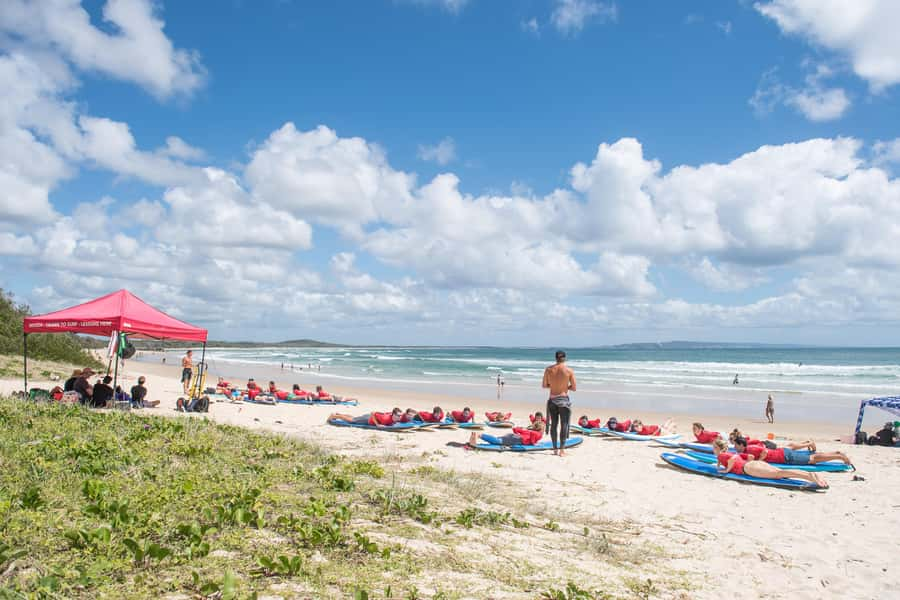
At $57 per person, this is a solid-value introduction if you are starting from scratch. You are not only paying for two hours in the water. The price also covers instruction from qualified surf coaches, a soft board, rash shirt or wetsuit, sunscreen, secure storage, and a shower.
The soft board is especially useful for beginners. It is designed to be safer and more forgiving than a hard performance board while you learn balance and positioning. You still need to handle it carefully, but you do not need to arrive with your own equipment.
The inclusion of protective clothing helps simplify the day. You need swimwear and a towel, rather than a full set of surf equipment. Food and drinks are extra, so plan those separately.
The value is strongest for first-timers and casual learners. If you already surf confidently, a group beginner lesson may cover material you know. The activity does offer beginner and intermediate lessons daily, so you should check that you are booking the level that matches your ability.
Who will enjoy this lesson most
I would recommend it first to adults and children aged seven or older who want a guided introduction rather than a solo attempt. The family-friendly minimum age and small groups make it suitable for a parent and child, couples, friends, or a solo visitor who wants an active morning.
It also works well as a shared activity. One couple used it as a surprise date, and the format gives you plenty of chances to laugh, encourage each other, and celebrate small improvements. You do not need to be an expert athlete to enjoy that part.
Nervous beginners are well suited to this class because the safety briefing comes before the water work and the coaches remain involved throughout. If you are unsure about your balance or uneasy around waves, tell your coach early. The supplied details emphasize patient, individual guidance.
Children under seven cannot participate, and the activity is not suitable for pregnant women. The instruction is in English, so you should be comfortable understanding spoken directions about safety and movement.
The small drawbacks to plan around
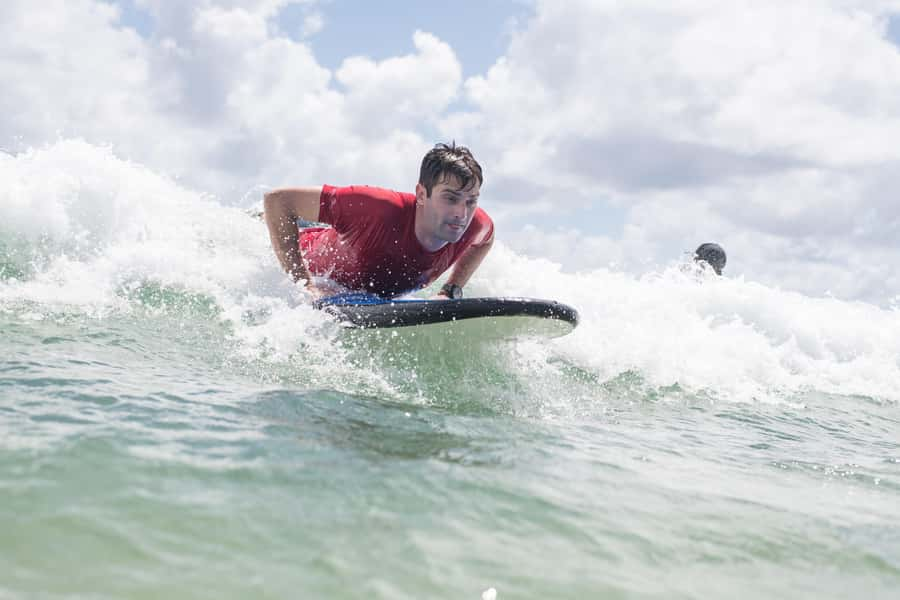
The parking issue is the clearest practical weakness. Noosa is a popular beach destination, and the advice to allow 30 minutes to secure a space is more important than the two-hour duration might suggest. If you have a car, build in that extra time.
You also need to carry your board along the pathway from the trailer to the beach. The walk is not described as far, but the board is bulky, and small children may need help managing it.
Do not expect a private lesson at this price. The group is limited to seven, which is small for a shared class, but you will still wait your turn for waves. The upside is that you can watch other beginners and learn from the same corrections.
Finally, standing up is not guaranteed. Many beginners succeed, and the coaches actively help you catch waves, but surfing depends on conditions and your own comfort in the water. Book this as a chance to learn and try, not as a promise of a perfect photograph.
Booking, cancellation, and the final call
You can cancel up to 24 hours before the lesson for a full refund, and the reserve-now-pay-later option lets you hold a place without paying immediately. Starting times vary, so check availability for your preferred day.
I would book this lesson if you want a well-supported first taste of surfing at one of Australia’s best-known beach areas. The strongest reasons are the protected North-facing setting, small groups, safety instruction, and coaches who focus on individual encouragement. The $57 price is fair because the board, protective clothing, sunscreen, storage, shower, and instruction are all included.
I would pause only if your schedule cannot absorb the parking delay or if you already surf beyond the beginner level. For everyone else, especially families, couples, and first-time surfers, this offers a practical way to learn the basics and possibly ride your first wave before lunch.
FAQ
Where does the surf lesson start?
Meet at Merrick’s Noosa Learn to Surf in the car park by the red surf trailer at Beach Access 14, Claude Batten Drive, Noosa Heads.
How long does the activity last?
The surf lesson lasts two hours.
How early should I arrive?
You should arrive 15 minutes before the lesson begins. During the busy tourist season, allow at least 30 minutes to find a car park.
What age can participate?
Participants must be at least seven years old. Children under seven cannot take part.
Is the lesson suitable for pregnant women?
No. The activity is not suitable for pregnant women.
What equipment is included?
The school provides a soft surfboard and a rash shirt or wetsuit. Sunscreen, personal-item storage in a lock-up trailer, and a shower are also included.
What should I bring?
Bring swimwear and a towel. Food and drinks are not included.
Is the lesson suitable for complete beginners?
Yes. The lesson covers beach safety, rip and current identification, board handling, standing technique, and assisted wave riding. Beginner and intermediate lessons are available daily.
What language is the instruction in?
The instruction is in English.
Latest surf sessions around Australia
- Learn to Surf at Sydney’s Maroubra Beach★ 4.5 · 25 reviews
- Australian Surfing and Camping Tours★ 5.0 · 8 reviews
- Sunrise & Surf Beach Lifestyle Photoshoot★ 5.0 · 3 reviews
- Rainbow Beach: Surf Lesson Safari & Beach 4WD Double Island Point★ 5.0 · 12 reviews
- Epic Surf Safari Beach 4WD Day Tour -Noosa to Double Island Point★ 5.0 · 34 reviews
- Private Surf Coaching Session in New South Wales★ 5.0 · 3 reviews
- Private Surf Lesson at Margaret River in Western Australia★ 5.0 · 6 reviews
- 2 Hour Adults Only, Learn to Surf Lesson in Torquay/Anglesea★ 5.0 · 6 reviews
Australia Surf Lessons, compared.
Bondi Beach: 2-Hour Surf Lesson Experience for Any Level
Read our review →
Noosa Heads: 2 Hour Surf Experience on the Sunshine Coast
Read our review →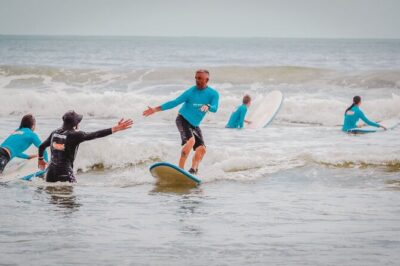
Broadbeach: 2 Hour Surf Experience on the Gold Coast
Read our review →Browse the lists this tour appears in