
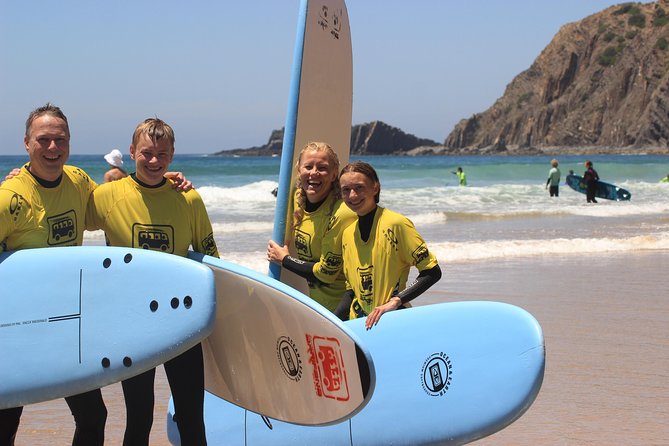
Review · PORTIMAO
Surf Lesson 2H
The key to this two-hour surf lesson is its careful order: first learn the board, the waves, and the stand-up motion on land, then take those skills into the water at Praia da Arrifana. That makes it a sensible first step for anyone who has never surfed or still struggles to stand.
I like the maximum group of five, which should leave room for direct help, and I like that safety covers more than a quick warning before the lesson. You will learn how to handle the board in white water, reach the point break, read the ocean, and time your take-off. The main drawback is simple: two hours goes quickly, and success depends on the day’s waves and your ability to put the land practice into action.
Key points at a glance
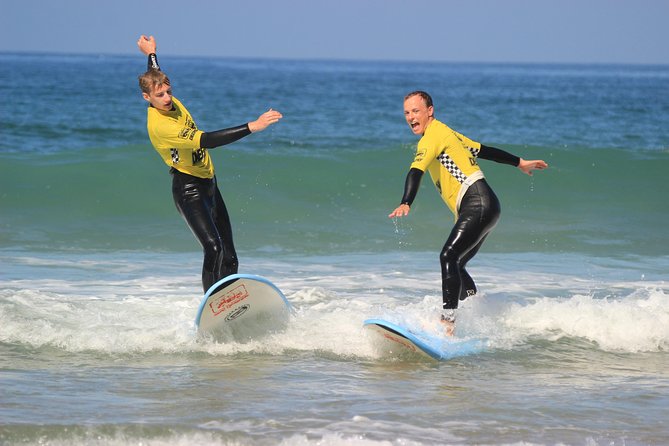
- Land practice comes first: You rehearse body position, paddling, and the stand-up motion before entering the water.
- Built for first-timers: The lesson is aimed at people who have never surfed or cannot yet stand on most attempts.
- Small maximum group: The class accepts no more than five people, a useful limit for hands-on teaching.
- Safety is part of the lesson: Board handling, white-water technique, ocean reading, and line-up position are covered.
- Praia da Arrifana meeting point: The lesson starts and finishes at the same beach location.
- Full equipment provided: You do not need to arrange the surfboard or other lesson equipment separately.
Starting at Praia da Arrifana
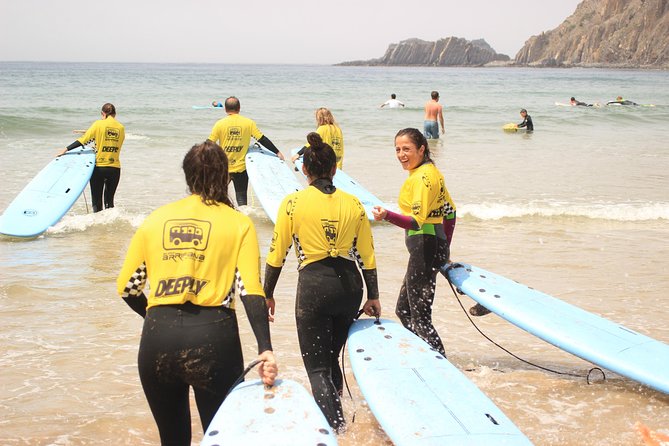
Your lesson begins at Praia da Arrifana, in Portugal’s Algarve region, with the end point back at the same meeting place. That simple arrangement matters. You are not trying to find a second location after a wet, active morning, and the meeting point is described as convenient and easy to find.
The class is offered daily between 8:00 a.m. and 6:30 p.m., with the exact lesson time set through booking. Surf schools often work around the conditions, and this broad operating window gives the provider room to place lessons at a useful time. Still, the supplied details do not promise a particular tide, swell, or beach condition, so you should treat the schedule as a stated operating range rather than a guarantee of perfect waves.
The setting also gives the lesson a useful sense of place. You are learning at the beach, not in a dry training room, and the instruction includes the geography of the surrounding area. That means the first part is not only about standing on a board. It is also about understanding where the water moves and how the beach fits into the wider ocean setting.
More Two-Hour Experiences in Portugal:
- Albufeira: 2-Hour Falesia Beach Surf Lesson
★ 4.8 · 464 reviews - 2-Hour Surf Lesson in Alentejo
★ 5.0 · 243 reviews - Algarve: 2-Hour Beginner Surf Lesson
★ 4.8 · 192 reviews
What happens before you enter the water
The teaching begins with an introduction to the equipment and basic safety rules. You will learn about the composition of a surfboard, how to carry and control it, and how to handle it in white water. These details may sound basic, but they are where many new surfers feel uncertain.
A board is large, buoyant, and awkward until you know how to work with it. The lesson gives you a chance to learn that handling before waves add speed and force. I consider this one of the strongest parts of the plan because it reduces the number of new tasks you must solve at once.
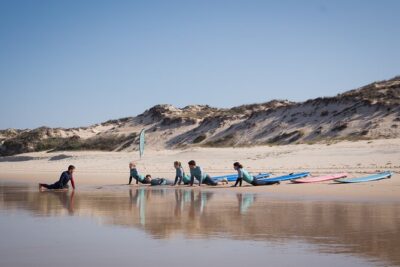
Next comes body position. You will practice how to lie on the board, how to sit on it, and how to place your body so the board can move properly. You will also work on paddling, since catching a wave is not only a matter of waiting for water to carry you. Your timing and position matter.
The stand-up motion, known as the take-off, is also practiced on land. You will work on moving from lying down to standing, then learn when to make that movement. The timing lesson is important. Standing too soon, too late, or in the wrong part of the wave can turn a promising ride into a quick fall.
The information provided does not specify exactly how long each section lasts. That is worth keeping in mind. A two-hour class may feel generous when you are learning, but the time includes explanation, practice, board handling, and water work. You should expect an introduction rather than a full course in surfing.
Reading the water at Arrifana
The school places strong attention on reading the ocean and respecting it. That is good surf teaching. A beginner who only learns the mechanics of standing may manage one brief ride but still lack the judgment needed to enter the water safely.
You will be introduced to how waves develop in the ocean and how to identify the line-up position. The line-up is the area where surfers wait for incoming waves, so learning where to sit and how to position yourself is part of becoming a responsible surfer. It also helps you understand that surfing involves more than chasing the nearest breaking wave.
The class also teaches techniques for reaching the point break with less effort. This is described as a key part of the learning process because you must combine paddling, positioning, board control, and ocean awareness to get into the right place. For a first-timer, that combination may be harder than the stand-up itself.
I like that the lesson does not treat the wave as a simple amusement ride. The instruction connects enjoyment with respect for the sea. You are being taught to watch what the water is doing, not just to copy a movement and hope for the best.
Of course, the lesson cannot remove all uncertainty from the ocean. Wave size, timing, and your own comfort in the water will affect how much you accomplish. The school says the lesson suits all levels and physical abilities, but beginners should still tell the instructor about any concern that could affect participation.
From white water to your first take-off
For a new surfer, white water is often the first useful training ground. The broken part of a wave can push the board forward without requiring the precision needed to catch an unbroken wave. That gives you a practical place to connect the land exercises with the moving water.
You will learn how to handle the board safely in that white water, paddle to catch a wave, and move into the stand-up position. The goal is not simply to rise once. It is to learn the sequence well enough that you can repeat it.
The lesson is designed for people who have never surfed and for people who are unable to stand on most attempts. That wording sets a fair expectation. You do not need to arrive as a capable surfer, but you should not assume that one lesson will make you independent in every condition.
The most useful result may be a clearer understanding of what to practice next. If you manage a few short rides, you will know how the take-off feels. If you do not stand successfully, you can still leave with a better grasp of board position, paddling, and wave timing.
The experience provider is Arrifana Surf School & Camp. The instructor names connected with the teaching include Peste, Pedro, and Manuel. The available comments particularly credit Peste with teaching the basics in a short time, while Pedro and Manuel are associated with a lesson described as helping a group catch waves alone the next day. Those outcomes are encouraging, but they should be viewed as possible results rather than promises.
More Surf Lessons around Portugal:
- Matosinhos: Surfing Lesson with Equipment
★ 4.8 · 926 reviews - Lisbon Surf Experience
★ 4.9 · 876 reviews - Albufeira: Surf Lesson
★ 4.7 · 699 reviews - Porto: Small Group Surf Lesson with Transportation
★ 4.9 · 594 reviews
Why the five-person limit matters
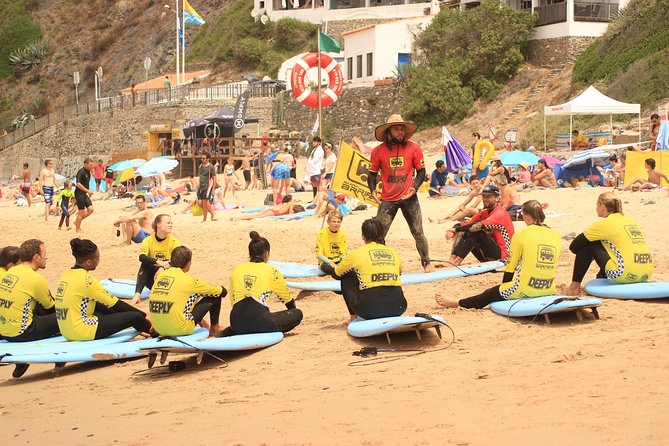
The class has a maximum of five participants. That is a meaningful feature for beginners because surf instruction works best when the teacher can see your body position and correct it quickly.
A small group can also make the safety explanations easier to follow. You should have fewer people competing for attention than in a large beach class, though the available details do not promise a one-to-one lesson or a specific instructor-to-student ratio.
The small maximum may suit friends or family members who want to learn together. It also gives you a chance to watch other beginners handle the same problems. Seeing someone else make the same mistake can make the correction easier to understand.
There is one practical limit. If all five participants need help at the same moment, you may still spend some time waiting for individual instruction. That is normal in a group activity and one reason to pay attention during the land demonstration.
Equipment, safety, and physical demands
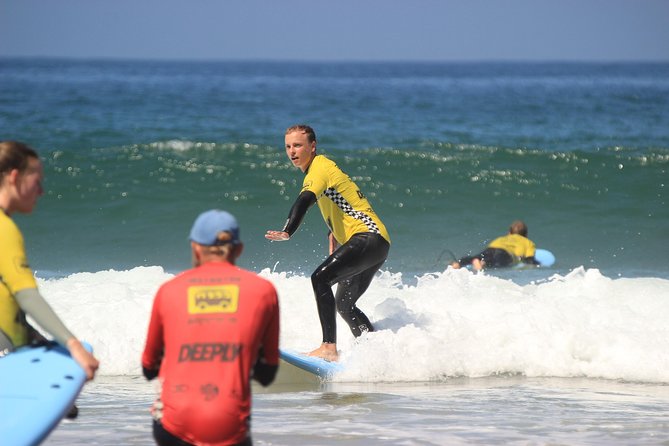
Equipment is provided, which keeps the price easier to understand. You are paying for instruction and access to the basic surf equipment rather than having to bring or rent a board separately. The supplied information does not list every item included, so you should not assume that personal clothing or any extra accessory is covered.
Safety is addressed through several parts of the lesson:
- How to handle the board in white water
- How to place your body on the board
- How to paddle and catch a wave
- How to reach the point break
- How to position yourself in the line-up
- How to read and respect the ocean
- When to stand up and how to time the movement
This is a useful list because it covers both personal technique and the shared water environment. You are not only learning how to protect yourself from the board. You are also learning how to behave around waves and other surfers.
Most participants can take part, according to the supplied details, and the lesson is presented as suitable for different levels and physical abilities. Even so, surfing requires you to lie, sit, paddle, and stand on a moving board. If you have a condition that affects those movements, it is sensible to raise it with the provider before booking.
Is $67.92 a fair price?
At $67.92 per person, this is not the cheapest way to spend two hours at the beach. The value comes from the guided structure, the certified teachers, the equipment, and the small group limit.
A casual board rental would not provide the same safety briefing or corrections to your technique. This lesson also covers subjects that are easy to skip when learning alone, such as board composition, line-up position, ocean reading, and how to reach the point break.
The price makes the most sense if you are starting from zero. A confident surfer who already knows how to paddle, take off, and read waves may find a beginner lesson too basic. Someone who has tried surfing but still fails to stand most of the time is closer to the intended audience.
The strong value is also tied to how actively you use the two hours. Pay attention during the land practice, ask for corrections, and treat the ocean-reading section as seriously as the stand-up motion. If you only wait for a wave and copy other people, the lesson will give you less for your money.
The activity is often reserved well ahead of time, with an average booking lead time of 39 days. That does not mean you must always book that far ahead, but it suggests you should not leave it until the last moment if your Portugal plans are fixed.
Who will enjoy this lesson most
I would choose this experience for a first-time surfer who wants a structured introduction rather than a loose try at the beach. It also suits someone who has attempted surfing before and still cannot stand consistently.
It can work well for a small group of friends because the five-person maximum keeps the class from becoming unwieldy. The shared start and finish at Praia da Arrifana also make it easy to fit into a day based in the Portimao area.
You should book with realistic expectations. Your main gain may be a first successful ride, but it may instead be a clearer understanding of why you are falling. Surfing has a steep first step, and conditions are not fully described in advance.
The experience is less suited to someone seeking a long surf session with minimal instruction. Two hours includes teaching and practice, so the time on the board will not equal two hours of uninterrupted riding.
Booking, timing, and cancellation
The activity has a mobile ticket and confirmation is normally sent at booking. If you book within 12 hours of the start, confirmation is sent as soon as possible and depends on availability.
You meet at Praia da Arrifana, and the lesson returns to that same point. The location is near public transportation, which helps if you are not driving, though no specific route or service is provided.
Free cancellation is available up to 24 hours before the start time for a full refund. Cancellations or changes made less than 24 hours before the start are not accepted for a refund. The cut-off uses local time, so check the time carefully if you are arranging the lesson from another time zone.
Should you book the Praia da Arrifana surf lesson?
Book it if you want a small beginner class with a clear teaching sequence, included equipment, and serious attention to safety. The land practice, ocean-reading instruction, and five-person limit give it more substance than a quick attempt to copy a surfer on the beach.
I would be especially comfortable recommending it to someone who has never surfed or who still cannot stand on most attempts. The reported success of catching waves after instruction is encouraging, and the names Peste, Pedro, and Manuel give the lesson a more personal feel.
Skip it if you already surf confidently or want a long, unsupervised session. For everyone else, $67.92 is a reasonable price for a focused introduction at Praia da Arrifana, provided you accept that the sea, not the lesson plan, has the final say.
FAQ
Where does the surf lesson start?
The lesson starts at Praia da Arrifana, Portugal.
Where does the activity finish?
The activity finishes back at the meeting point at Praia da Arrifana.
How long does the surf lesson last?
The lesson lasts approximately two hours.
Who is the lesson designed for?
It is designed for people who have never surfed or who cannot stand up on a surfboard on most attempts.
Is equipment provided?
Yes. The activity includes the equipment needed for the lesson, though the supplied details do not list every individual item.
How many people can join the lesson?
The activity has a maximum of five participants.
Is the lesson available every day?
The listed operating hours are Monday through Sunday, from 8:00 a.m. to 6:30 p.m.
Can I cancel for a full refund?
Yes. You can cancel at least 24 hours before the experience start time for a full refund. Cancellations or changes made less than 24 hours before the start are not accepted for a refund.
Latest surf sessions around Portugal
- Tricana Surf Experience★ 5.0 · 3 reviews
- Exclusive Surf Lessons in S Miguel Azores★ 5.0 · 21 reviews
- Guided surf tours from Porto city to the beach★ 4.5 · 10 reviews
- Surf Lesson | Surf Lessons★ 5.0 · 39 reviews
- Self-guided tour Bike + Surf★ 5.0 · 6 reviews
- Surf Lessons in Porto with transfer at Porto Surf School★ 5.0 · 42 reviews
- Private Surf Experience – Transfer to Matosinhos – All Levels★ 5.0 · 7 reviews
- Small Group Surf Coaching in Porto with photos★ 5.0 · 28 reviews
Portimao Surf Lessons, compared.

Browse the lists this tour appears in