
Review · LOMBOK
Senggigi Surf lesson packages – 3 lessons
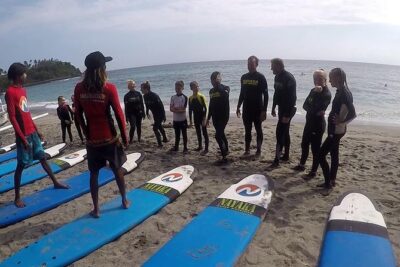
Senggigi is a sensible place to learn surfing if you want small crowds and patient instruction, rather than being dropped into a packed lineup. Nayaka Surf School builds the course over three days, giving you time to work on paddling, wave choice, standing up, and staying safe instead of trying to learn everything in one rushed session.
I like the 2.5 to 3-hour lessons, which leave enough time for explanation and practice. I also like that pickup around Senggigi, boards, reef shoes, a rash guard, water, and inbound travel insurance are included. The main catch is simple: you need to stay in Senggigi for three days, and the price of $153.85 does not cover lunch, airport transfers, board shorts, or personal expenses.
Key points before you book
- Three separate lessons: Each session lasts about 2.5 to 3 hours, giving you time to build skills gradually.
- Designed for beginners: You learn paddling, positioning, takeoff, wave riding, safety, and surf manners from the start.
- Less crowded water: The school presents its teaching area as a quieter Senggigi spot, useful when you are still finding your balance.
- Useful equipment included: Board rental, wetsuit or rash guard, reef shoes, and mineral water are part of the package.
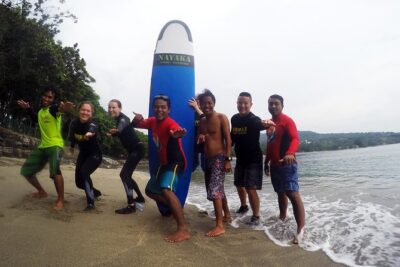
- Personal instruction is possible: Tommok and Ady are named as instructors in the feedback, with one student pair describing individual attention.
- Convenient local pickup: Pickup is offered in the Senggigi area, but the course begins and ends at Nayaka Surf School.
Why three days makes sense in Senggigi
A one-off surf class can give you the thrill of standing on a board, but it often ends just as your body starts to understand what it is doing. This package spreads the work over three days. That matters because surfing is not one skill. You need to paddle well, read the water, choose a wave, get to your feet, and keep your balance while moving.
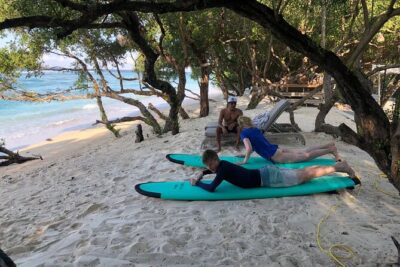
The first lesson should feel like a mix of beach briefing and board practice. You will learn how to position your body while paddling and how to use your arms efficiently. You will also work on where to sit or lie in relation to the incoming waves, since being in the wrong place can make even a good paddle useless.
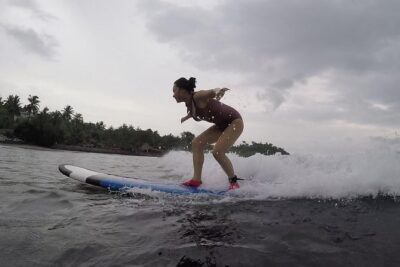
The next useful step is learning the takeoff. This is the quick movement from lying on the board to standing in a stable position. The course also covers body position while riding, so you are not simply trying to stand for a second before falling off. The aim is to ride a basic wave with better control.
The third class gives you more room to connect those skills. You will keep practicing wave entry and riding, while also learning to observe the surf area. That includes judging the safest place to enter and leave the water, an important lesson that many first-time surfers overlook.
Each session is long enough to include instruction, practice, and correction. It is still physical work, and three consecutive days may leave your shoulders and legs tired. If your fitness is limited, expect to pace yourself and listen carefully to the instructor.
More Surf Lessons around Indonesia:
- Canggu: 2-Hour Surf Course
★ 4.8 · 1,053 reviews - Legian Beach, Bali: Beginner or Intermediate Surf Lessons
★ 4.9 · 1,019 reviews - Uluwatu: Beginner & Intermediate Surf Lesson with Equipment
★ 4.9 · 832 reviews
Starting at Nayaka Surf School on Raya Senggigi
The meeting point is Nayaka Surf School on Jalan Raya Senggigi in Batu Layar, West Lombok. The activity returns to this same point at the end, so you do not need to arrange a separate ride back from the lesson.
Pickup is offered within the Senggigi area. That is useful if you are staying nearby and do not want to carry a surfboard through town. The included pickup does not extend to the airport, so you will need to arrange airport transport separately.
The school is near public transportation, which gives you another option if you are not using the pickup service. Still, confirm the exact pickup details when booking, especially if your hotel is outside the main Senggigi area.
The group limit is 10 people. That is not the same as a private lesson, but it keeps the maximum manageable. The level of personal attention can still depend on the number of people booked and the instructor setup on your chosen day.
One especially useful detail from the feedback is that a couple received individual instruction from Tommok and Ady. That suggests the school may arrange close coaching for some students, but you should not assume a private instructor is guaranteed unless it is confirmed directly.
What you learn before you chase waves
The course has a practical structure. You are not only shown how to stand on a board. You are taught how to make sensible choices in the water.
Here is what the instruction covers:
- How to position your body while paddling
- How to paddle with better efficiency
- Where to position yourself to catch a wave
- How to perform the takeoff
- How to position your body while riding
- How to enter and ride a basic wave
- How to observe and assess the surf area
- How to choose safer entry and exit points
- Basic safety measures and surf etiquette
- The different designs and functions of surfboards
That last point is worth your attention. Beginners often see a board as a floating platform, but board shape affects stability, speed, and handling. Understanding the basic differences helps explain why an instructor may choose one board for learning and another for more experienced surfing.
Safety instruction is equally important. You will be asked to consider where to enter the water and how to get out safely, rather than simply following the nearest path to the shore. You will also learn surf etiquette, which covers the basic manners that help prevent collisions and arguments in the water.
The quieter teaching area is helpful here. A beginner needs room to think. In a crowded break, you may spend more time avoiding other boards than practicing your own movement.
Lesson one: board control and water awareness
Your first class is about building a reliable base. You will work on body position, paddling, and the mechanics of getting into a wave.
Paddling looks easy from shore, but poor body placement can make the board slow or unstable. The course teaches you where to place yourself and how to paddle efficiently. These details save energy, which matters once you begin repeating the same movement over several waves.
You will also learn where to position yourself in the water. Catching a wave is not just a matter of waiting and hoping. You need to be in a useful place, facing the right direction, and ready to move when the wave approaches.
This session should also introduce the board itself. You will learn about different surfboard designs and their functions. That is practical information if you plan to take more lessons later, since it gives you a better sense of why beginners usually need a stable board.
Expect plenty of correction. A good beginner class is not about looking stylish. It is about learning a few movements correctly enough that you can repeat them.
Same water, another way to ride it:
- Kuta/Bali: Private Beginner & Intermediate Surf Lessons
★ 4.9 · 563 reviews - Canggu: 2-Hour Surf Class with a Professional Instructor
★ 4.9 · 355 reviews - Canggu: Surfing Lesson with ISA Instructor
★ 4.9 · 232 reviews - HOT PROMO. Beginner Surf Lessons in Bali
★ 5.0 · 193 reviews
Lesson two: the takeoff and first rides
The takeoff is the moment many new surfers find hardest. You must move quickly, keep the board straight, place your feet correctly, and rise without pushing the board off balance.
The course treats takeoff as a specific skill, rather than leaving you to copy someone else. You will also work on your body position while riding. That gives you a better chance of staying with a wave after you stand.
This is likely the class where the experience begins to feel like real surfing. You may still fall often, but you will understand more clearly why you fell. Was your position too far forward? Did you stand before the wave had enough speed? Did your feet land in the wrong place? Practical feedback can turn those questions into progress.
The school’s beginner focus is a strong fit for couples and friends who are starting together. One couple specifically received personal help from Tommok and Ady, with both instructors focused on individual needs. You should expect instruction to be adjusted to your ability, though exact staffing can vary.
Do not measure the lesson only by the number of waves you ride. Learning to recognize a suitable wave and preparing correctly is progress too.
Lesson three: linking the skills together
By the third session, you will have had time to test the basics. This lesson continues the work of entering a wave and riding it, while adding better awareness of the area around you.
Observing the surf is not passive. You need to notice how waves approach, where people are positioned, and which part of the water gives you the safest route. The course includes guidance on judging entry and exit points, which is useful long after your first successful ride.
This session can also help you decide if surfing suits you. Three days is enough to experience the physical demands without committing to a longer surf camp. If you enjoy the learning process, you will leave with a clearer idea of what to practice next.
The activity ends back at the school. One piece of feedback describes the instructor helping with laundry and driving the students to the boat after their third lesson. That kind of extra help is not listed as a formal service, so treat it as a possibility rather than something included in the package.
Boards, clothing, and what you still need
The price includes a surfboard, instructor, wetsuit or shirt, reef shoes, and mineral water. Reef shoes are particularly useful for a beginner, since they protect your feet while you are learning how to move in and out of the water.
Board shorts are not included. Bring your own if you have them, or plan to buy or rent them separately. Soft drinks and lunch are also excluded, so budget for food around your lesson.
The equipment is described as clean beginner gear in the available feedback, while the school facilities are described as ordinary but clean. That is a fair expectation. This is a surf school built around instruction and equipment, not a luxury resort.
You should bring any other personal items you need for a half-day at the water. The package includes mineral water, but it does not promise meals or other refreshments.
Is $153.85 good value?
At $153.85 per person, the package works out to roughly $51 per lesson before considering the included equipment and pickup. That is a reasonable way to assess the price, since you are buying three long sessions rather than a single short introduction.
The value is strongest if you need a board and safety equipment. Board rental, a surf instructor, reef shoes, a rash guard or wetsuit, mineral water, government tax, and inbound travel insurance are included. Paying separately for several of those items could make a casual lesson more expensive.
The package is less useful if you already own surf equipment or only want to try surfing once. In that case, a single lesson might fit your schedule and budget better, though this three-day course offers a clearer learning path.
You also need to include the cost of three nights in Senggigi, because the classes run over three days. Airport transport, lunch, board shorts, soft drinks, tips, and other personal costs are outside the stated price.
For a beginner planning to base themselves in Senggigi, the price makes sense. For someone passing through Lombok for one day, the schedule is the main obstacle.
Who will get the most from this course
I would choose this package if you are new to surfing and want more than a quick photo standing on a board. Three lessons let you repeat the basics and receive corrections before moving on.
It should suit:
- First-time surfers
- Couples or friends learning together
- People staying in Senggigi for at least three days
- Visitors who want equipment included
- Beginners who prefer a less crowded teaching area
- People with a moderate level of physical fitness
It may not suit you if you are looking for advanced coaching, a luxury surf camp, or a package with meals and airport transport. The maximum group size is 10, so you should also ask about the expected class size if close personal coaching is your top priority.
The course is physically active. You will paddle, repeatedly attempt takeoffs, and spend extended time practicing. You do not need to be an athlete, but a moderate fitness level is required.
Booking, weather, and cancellation details
Confirmation is provided when you book. You can cancel up to 24 hours before the experience start time for a full refund. Changes or cancellations made less than 24 hours before the start time are not accepted for a refund.
The class depends on suitable weather. If poor conditions force a cancellation, you will be offered another date or a full refund. The school also requires a minimum number of participants, so a cancellation for that reason comes with the choice of another date or experience, or a full refund.
Senggigi uses local time for the cancellation cut-off. Keep that in mind if you are booking from another country.
My verdict: a strong beginner course with a clear schedule
I would book the Nayaka Surf School three-lesson package if I were staying in Senggigi and wanted a proper introduction to surfing. The course covers the right building blocks, the sessions are long enough to be useful, and the included equipment keeps the cost easier to understand.
The strongest reasons to choose it are the quieter teaching setting, practical safety guidance, and the chance to work with instructors such as Tommok and Ady. The main drawbacks are the three-day commitment, extra costs for food and airport transport, and the fact that a group of up to 10 may not feel fully private.
Book it if you want patient beginner coaching and can give the sport three days. Choose something shorter if you are only curious about surfing or have a tight Lombok schedule.
FAQ
Where does the surf lesson package start?
The activity starts at Nayaka Surf School, Jalan Raya Senggigi, Batu Layar, West Lombok, Indonesia.
Where does the activity end?
The activity ends back at the Nayaka Surf School meeting point.
How long is each surf lesson?
Each class lasts approximately 2.5 to 3 hours.
How many days does the package take?
The package includes three lessons over approximately three days, so you need to stay in a Senggigi hotel for that period.
Is pickup included?
Pickup is offered in the Senggigi area. Airport transfer is not included.
Is surfboard rental included?
Yes. Surfboard rental is included in the package price.
Are reef shoes and surf clothing included?
Reef shoes and a wetsuit or shirt are included. Board shorts are not included.
Is lunch included?
No. Lunch, soft drinks, tips, and other personal expenses are not included.
How many people can join the activity?
The maximum group size is 10 people.
Can I cancel for a full refund?
Yes. You can cancel at least 24 hours before the experience start time for a full refund. Poor weather or failure to meet the minimum number of participants may also lead to a different date or a full refund.
Latest surf sessions around Indonesia
- Uluwatu: Surf Lessons Beginner★ 5.0 · 3 reviews
- 2-Hour Canggu Private Guided Surfing Experience in Bali★ 5.0 · 3 reviews
- Surf lesson | Energy surfschool krui★ 5.0 · 3 reviews
- Surfing Lesson in Canggu★ 5.0 · 2 reviews
- Surfing Trip or Lesson with Coaching in Bali★ 5.0 · 19 reviews
- Private One on One Surf Lesson in Canggu area – Bali★ 5.0 · 13 reviews
- Private Experience Surf Lessons in Canggu★ 5.0 · 9 reviews
- 2 hour Private Bali Surf Lesson in Seminyak★ 5.0 · 6 reviews
Lombok Surf Lessons, compared.
Amazing 5 days surf camp packages Senggigi Lombok
Read our review →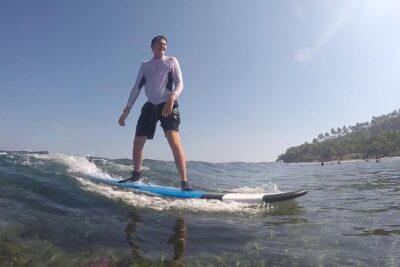
Browse the lists this tour appears in